 "
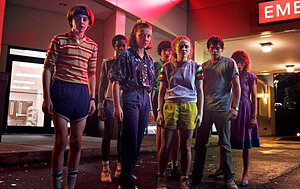
There is little new about the aesthetic of today. “Stranger Things” has amassed the love of its many viewers for its distinctive ’80s soundtrack and costume design. 1989 is not only the year Taylor Swift was born; it is the year her synthpop-revival album resides permanently in. We cannot escape these borrowed aesthetics. We are nostalgic for an era we never experienced. What is fashionable today — digital cameras, high-rise jeans with flare legs, go-go boots, sugary sweet pop music — does not belong to us.
Less people are nostalgic about what the 1980s signified for those who lived through the time. There is little to wax over in the AIDS crisis, the crack epidemic or the Iran-Contra affair. Even “Stranger Things,” a show wholeheartedly dedicated to glamorizing Reagan-era America, transforms the Cold War into a cartoonish conflict between the comically evil Russian scientists and some wide-eyed but resourceful teenagers. Disco music is fresh and trendy; the discoculture of the late 1970s — how it arose as a safe haven for oppressed and primarily black and/or queer populations — is forgotten.

Something is lost in the revival of bygone aesthetics. The synthpop-revival music exists in the shadow of the political climate of the 1980s, forever unspoken. The renewed interest in these fashions and trends of the past pay no homage to the cultural moment from which they arose. The aesthetic symbols are emptied of their historical weight. Fredric Jameson theorized about this phenomenon in his 1984 essay “Postmodernism, or the Cultural Logic of Late Capitalism.” When we make trendy again the trends of the past, we draw the aesthetics of the ’80s, as it were, into an eternal present. There is no longer a distinction between the past ’80s and the present 2020s; the two epochs become an amorphous ahistorical period.
This phenomenon already existed for Fredric Jameson in the 1980s, the time period from which we now in 2026 borrow. He observes the 1981 film “Body Heat” is a “distant remake” of the 1944 film “Double Indemnity.” “Body Heat” takes place in an ambiguous contemporary setting outside the hustle-and-bustle of 1980s consumer society; its title card calls vaguely to the 1930s art-deco style; the film exists, so to speak, in a land beyond history, where it is the 1930s forever.
We occupy the same land beyond history; it is the 1980s forever, as well as the 1990s and the 2000s and now even the 2010s forever. Time does not continue to flow. Genuine innovation is hard to come by; everything new is something old. Fredric Jameson says it remains to be seen whether we can un-freeze history, as it were, and create that “something new.” A genuinely new aesthetic — one that belongs to 2026 — would require that we find the beauty in 2026, and extract that beauty from our historical moment in all its weight. To be sure, that is no small ask. There’s little to find beauty in these days. But the great subversive art of days past — Fellini’s “La Dolce Vita” or Flaubert’s “Madame Bovary” — began with finding something beautiful in the historical moment the creator occupied.