 "
"
It’s the morning of Sept 14, 2025. You’re lying in your bed doing your routine morning scroll on social media, when you’re bombarded with one-lined graphics, hot takes and endless criticism threads scrutinizing Notre Dame football after their shortcoming against Texas A&M the night before. In their 2025 season, Notre Dame not only played football on the field under the watchful gaze of Touchdown Jesus, but on social media, where every moment was heavily debated. Social media now has the power to affect the public perception of the team, players and even coaching perspectives, something that has transformed the college football landscape into a cycle of reaction and debate.
Every missed tackle, questionable play call, and turnover was clipped and had made its journey around social media platforms, sometimes before the alma mater even played. Notre Dame opened the season with a tough loss against Miami. While everyone was lamenting the loss, social media sparked a whirlwind of discussion. Memes and highlight clips spread quickly, which made the loss feel heavier than it was on the field. People online were quick to criticize offensive coordinator Mike Denbrock and CJ Carr’s decision not to run the ball, earning 17,700 views on X. Despite the negative narratives surrounding the loss, former wide receiver Robby Toma was optimistic and shared his views, comparing the loss to that of NIU one year prior, saying Notre Dame was “something special.”
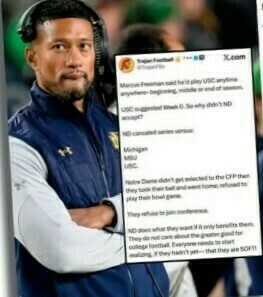
That optimism was short-lived after a loss to Texas A&M, which only intensif ied the negativit y surrounding Irish football. X users like @PeteSampson_ declared the “nationally relevant portion” of their season was over. Others analyzed individual plays, including former NFL referee Terry McAulay, who posted a video analysis of a missed offensive holding call that could’ve changed the trajectory of the game. Yet many reporters gave Notre Dame fans hope, posting quotes from Jeremiyah Love, who said, “loss hurts...I want to get back to work right now.” Narratives such as “Notre Dame can’t win big games” and “Freeman is soft” became accepted opinions before week three due to the volume of discussion.
Chris Ash found himself in the eye of the hurricane. No narratives were magnified at the same speed as the criticism of Notre Dame’s defensive coordinator, who became the target for frustrated fans. Defensive breakdowns were clipped and circulated across every platform-often without context- which only intensified calls for his removal. “Fire him yesterday” posts were everywhere, and even prominent voices such as author Jack Sacco urged head coach Marcus Freeman to replace him. The online discourse was impossible
for Ash to escape. Freeman addressed the situation directly, emphasizing that the real issue was the execution, not the call. However, many fans dismissed the explanation, and the criticism continued until another Irish narrative pulled the attention away from the defense.
Online perception of Notre Dame reached its peak when the College Football Playoff rankings were released, and Notre Dame chose not to participate in a bowl game. Despite the Irish boasting an impressive resume, social media had already declared Notre Dame irrelevant and out of the bracket. Rankings that consistently ranked Notre Dame over Miami for weeks leading up to the selection show were suddenly flipped, promoting discourse, with sportscaster Mike Monaco noting the switch was “nonsensical.”
National media was somehow worse, with late-night SportsCenter following the selection show opening with “Uh, hello, Notre Dame, hello, are you there? No, they're not.” Although meant playfully, it quickly turned into a viral clip, only reinforcing the negativity around this moment.
Notre Dame is not alone in this new age of digitalization; lots of collegiate programs face similar challenges; however, they may not be as amplified on our explore pages since we are tailored to see Notre Dame content. Take the University of Michigan’s football program, for example, which became the center of criticism that shaped the public’s perception of the program. It has become increasingly common for fans to experience sports through social media, whether it’s through online reaction videos, graphics, or even hot take accounts. Not only does this extended media presence affect the fan experience, but it has also become a main avenue for how teams build and maintain their reputations.