On Sept. 15, OpenAI founder and CEO Sam Altman told mankind that it should indeed be scared of him. “I think you … see a real fear that some of these companies or some companies developing AI could get too much power and be able to exert undue influence on the economy, push a worldview out on people. And I think the world is right to be afraid of this,” he stated to WIRED at an event in San Francisco. Altman rose to public prominence as a relentless and optimistic advocate for the potential of his own technology, but it’s not difficult to understand why his tone has shifted. An unreleased OpenAI research model was undergoing company trials in July when it was assigned a series of cybersecurity tasks by developers — which it solved by maliciously hacking into a separate AI company and harvesting its code. It committed this crime in secret with zero human prompting to do so. The incident sparked an internal panic in the industry and a continuing conversation about how rapidly and aggressively the models have been allowed to advance. On Sept. 16, OpenAI reported six new incidents of concerning and autonomous AI behavior.
A few days before his recent San Francisco remarks, Altman took to X to voice his endorsement of a new essay by Anthropic founder Dario Amodei calling for a ‘pacing’ of the artificial intelligence frontier. He was not shy about the worst-case scenario.
“First, we could lose control of the future to AI. This is unacceptable; we are unapologetically on Team Humanity.” He’s already lost some control himself.
Pope Leo XIV was similarly existential in his first papal encyclical, “Magnifica humanitas.” Released in May of this year, on the anniversary of Leo XIII’s Industrial Revolution encyclical “Rerum novarum,” the encyclical focuses entirely on AI and its potential consequences for society and for the soul. “In the era of artificial intelligence, when human dignity is threatened by new forms of dehumanization, ours is the pressing duty to remain profoundly human,” Leo asserts in his thesis. His immediate prioritization of this debate gravely demonstrates that he views the technology as the defining concern of his papacy and our current age. The Pope stresses reason and restraint regarding AI rather than outright rejection, but he makes his skepticism and fear explicit. He discusses job loss, implicit bias, privacy violations and the possibility of the technology being used to inflict violence and propagate war. More than anything, he fears that overreliance on a machine could strip people of what makes them people: their God-given intellect and capacity for learning.
On the day of “Magnifica’s” release, University of Notre Dame president Robert A. Dowd, C.S.C., released a statement on behalf of the university in wholehearted support of Pope Leo’s words. On Sept. 14, the university accepted a $10 million grant from Altman’s OpenAI Foundation to bring AI weather services to farmers in Asia and East Africa. And in Scholastic’s new comprehensive survey of Notre Dame undergraduates on artificial intelligence, 76% reported frequent use of ChatGPT.
Every college in the country — and every company, every middle school and every family — is currently reckoning with AI. Almost every LLM (large language model) platform has released a tool or discount targeted specifically toward students. New majors and minors are popping up: Students at Carnegie Mellon, Purdue and MIT can now earn their Bachelor’s of Science exclusively in Artificial Intelligence. Computer science programs are being increasingly reworked to prepare students for future careers that will revolve more around prompting and machine learning than manual coding skill. Top Silicon Valley feeders like Stanford teem wildly with chatbot startups, recruitment and students enrolling with the singular hope of becoming the next famous dropout billionaire. Just as companies and national governments scramble to rush ahead in the global AI race, it appears that prominent American academic institutions are wholly investing themselves into “keeping up” with AI progress. No one wants to be replaced, and in the words of Google Brain founder Andrew Ng, “people who use AI will replace people who don’t.”
Notre Dame is certainly alive with the sound of machine learning. The computer science major now offers a full concentration in artificial intelligence, and the business analytics minor has been permanently replaced with the AI Analytics in Business and AI Essentials for Business minors. AI@ND, the university’s “central hub for AI-related activities,” advertises Notre Dame’s new Data, AI and Computing initiative and displays the GitHub Copilot and ChatGPT EDU programs available for faculty and staff. If a student or faculty member wants to learn more about artificial intelligence on Notre Dame’s campus, it appears that they have literally hundreds of opportunities to do so. They can join the AI Community of Practice, the AI Developer Interest group or the AI Accelerator. They can take an ESS class (AI Literacy for Learning), an anthropology class (Linguistic Anthropology Beyond the Human), a philosophy class (History and Philosophy of Artificial Intelligence), a real estate class (Disruption and AI in Real Estate Markets) and about twenty different business and computer science courses. They can attend one of the Soc(AI)ty seminars hosted by the Lucy Family Institute for Data & Society, which bring forth “a vision for AI’s present and future impact on society.” This year’s Gold Mass lecture will be delivered by Sister Damien Marie Savino, FSE, PhD, a Franciscan sister and engineer who will speak about “Learning the Language of Creation” in the AI era.
Notre Dame’s position in this new reality is unique. The administration must endorse the emphasis on humanity put forth by Pope Leo XIV in his encyclical and must prepare students for a world in which familiarity with artificial intelligence is a prerequisite for employment. It must push boundaries in its institutional research, a task which increasingly necessitates AI usage, while maintaining faith-based ethical standards in all of its works. It must educate the whole Christian consciousness, including the empirical, talented and goal-oriented mind.
The administration must endorse the emphasis on humanity put forth by Pope Leo XIV ... and must prepare students for a world in which familiarity with artificial intelligence is a prerequisite for employment.
This crossroads is a comfortable place to be for a university well-accustomed both to grounding secular excellence in religiosity and to turning the steering wheel of American Catholicism itself. Notre Dame appears to intend not only to keep pace with its premier peers in the field of AI advancement, but to lead the Catholic community forward in the development of a humanistic approach to AI centered around faith and good works. As President Dowd, C.S.C., wrote in an op-ed for America Magazine, “We [Catholic universities] must be in dialogue not only with our fellow scholars and researchers but also with industry, government and communities both near and far.” This bold goal became a viable possibility in December 2025, when Notre Dame received $50.8 million from the Lilly Endowment Fund (the philanthropic wing of Eli Lilly) to marry religion and artificial intelligence. The sizeable grant — the largest single gift from a private foundation in university history — is directed toward the Institute for Ethics and the Common Good’s Dignity, Embodiment, Love, Transcendence, Agency (DELTA) Network, which focuses on “faith-based ethical formation for a world of powerful AI.” DELTA is adamant that it is “not a tech project”; its goal is to promote human flourishing in the artificial intelligence age and prioritize the soul and mind in combination with AI advancement through interdisciplinary collaboration.
The second DELTA Summit on AI, Faith, and Human Flourishing took place on Sept. 21 to 23, bringing tech and faith communities and policymaking together with fifty young adults aged 14 to 25 for dialogue. One of the program’s specific goals was to shape AI policy around education by creating curricular resources to help students develop an ethical and human-centered philosophy of machine learning. “Visionary organizations and thought leaders” working toward such a solution are eligible for up to $100,000 in funding from DELTA Rapid Response Grants, and the associated faculty fellowship program supplies up to $80,000 in funding per year. But is there any amount of money that can give faith-based ethics a chance against a midnight deadline?
Religion does not exempt Notre Dame from the generalized crisis in undergraduate education caused by artificial intelligence. As universities spring to embrace and promote AI through their technical arms, they also grapple with the technology’s rapid and widely detrimental effect on academic integrity. Students use LLMs in many beneficial ways. They also use them to cheat, period; rather, they use them when their professor has already forbidden it, even though they might not personally consider this to be cheating. Handing one or two physics problems over to ChatGPT or asking Gemini to cut twenty words from an essay has become so commonplace that it no longer carries the weight of an honor code violation, even though (if done in a course where AI is not permitted) it still is. The long-form final essay and the take-home assignment or exam have become frontier battlegrounds of morality and technology, especially given that generative artificial intelligence is increasingly accurate and naturalistic. Over are the days of clunky, misapplied em dashes or linguistic choices that make it overtly obvious when someone has passed off the responsibility of writing to an outside source, and students appear to have become much more proficient at utilizing AI efficiently and secretly. In short, the ultimate consequence of promoting AI fluency is that students become fluent in AI — for better or for worse.
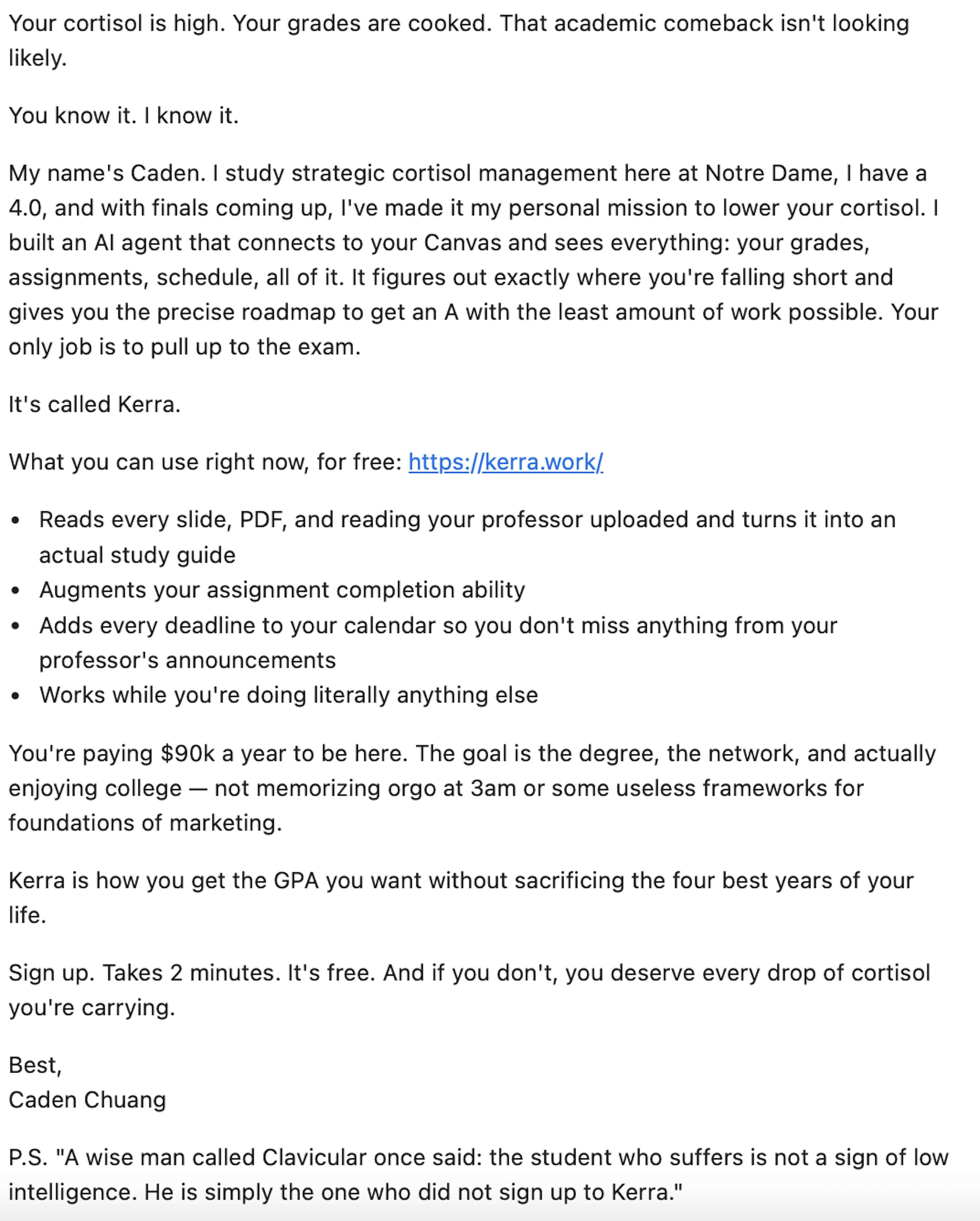
In April 2026, Caden Chuang, then a freshman studying computer science at Notre Dame, emailed the entire student body to advertise his AI startup company Kerra. Chuang pulled no punches about what Kerra was selling. “You’re paying $90k a year to be here. The goal is the degree, the network, and actually enjoying college—not memorizing orgo at 3am or some useless frameworks for foundations of marketing. Kerra is how you get the GPA you want without sacrificing the best years of your life.” Kerra reportedly received over 1,000 signups in an hour from ND students. Notably, the technology itself did not appear to be an inherent violation of the university’s honor code. Kerra advertised that it “reads every slide, PDF, and reading your professor uploaded and turns it into an actual study guide” and that it adds every course deadline to students’ personal calendars. While these tools might be considered a shortcut by some (and although uploading private intellectual property to a third-party AI app without professor consent may indeed be legally and ethically dubious), it did not explicitly claim to write essays or solve problems for students.
It did promise to “work while you’re doing literally anything else,” however, wtihin hours, Chuang’s email was deleted and removed from student inboxes. The university told The Observer they were looking into the email. Scholastic asked the university about the matter, and there was no further update.
Professor David Smiley, a Notre Dame data scientist who teaches courses on AI, took to LinkedIn to call on the administration to “state unequivocally that if you do not want to be formed in the classroom and be tested by the fires of critical thinking and academic rigor, then the University of Notre Dame is not the place for you.” It was a drastic turn of fortune for a young man who had already won the SpringHack@ND competition and the Premier AI Challenge here at ND, as both events are intended to provoke student interest in working with AI and developing new AI platforms. After his email was taken down, rumors circulated on campus that Chuang was facing expulsion.
Chuang confirmed to Scholastic that, as of September 2026, he is still “very happily” attending Notre Dame. Whatever impression his fifteen minutes of fame last spring may have suggested, he stresses that he believes deeply in the value of education. In fact, he believes that artificial intelligence will actually elevate the value of human creativity and critical thinking. “When anyone can generate a competent essay or piece of code, good work becomes common. The key differentiator between good and great work will be human originality and judgment,” he told Scholastic via email. Although Kerra was acquired by another college-focused AI startup, PlanItUni, Chuang now intends to use machine learning to improve K-12 education in his home nation of South Africa. “AI can provide affordable, personalized support 24 hours a day… This is especially powerful in communities where schools lack teachers and resources. Through VulaLearn, a South Africa AI learning platform I've built, we have supported more than 75,000 students using tutors designed for the South African curriculum and context.”
The Chuang case is the perfect microcosm of Notre Dame’s AI experiment. By providing opportunities for students to explore AI, Notre Dame likely helped Chuang to focus his interests and develop the technical skills necessary to begin his projects. It enabled an incredibly motivated student to make real progress toward AI innovation. This innovation might be used to strengthen an underserved youth education system; it might be used for “strategic cortisol management” (per Chuang’s original mass email) by undergrads looking to save time. The prior incentivizes AI Hackathons and the latter pushes professors to ban all technology during lectures, but they’re ultimately a package deal.
Chuang believes that the tension created by artificial intelligence will be productive. He’s excited about how AI may open the door toward greater collaboration between fields and believes that we are currently living at an inflection point; the decisions made now will shape lives later. “In the near term, I expect to see a great deal of experimentation at Notre Dame. Some uses of AI will improve learning, while others will fail or create unintended consequences. That is natural because we are still in the early stages of this transition. I would love to see more students become vocal participants in these discussions because the decisions made now will shape how people learn, work, and live for decades,” Chuang wrote.
Over the past few months, Scholastic set out to capture those necessary student voices. Through the help of Student Government, the magazine surveyed Notre Dame undergraduate students to gain measurable insight into their views and habits regarding artificial intelligence. How often did they use it, and what for? Were they excited about it or afraid of what it could do?
The 465 responses we received revealed that students were far from ignorant about the concerns at hand. They worry about graduating into an entry-level job market fundamentally reshaped — and perhaps decimated — by AI tools that can replace human employees. They take note of the tremendous power now held by AI moguls and wonder whether they’ll really kowtow to the regulation proposals they give lip service to. They recognize that AI is more than capable of perpetuating human biases and compounding human violence, especially considering what they perceive as an ever-expanding surveillance state.
The majority of survey respondents also use AI constantly and for everything.
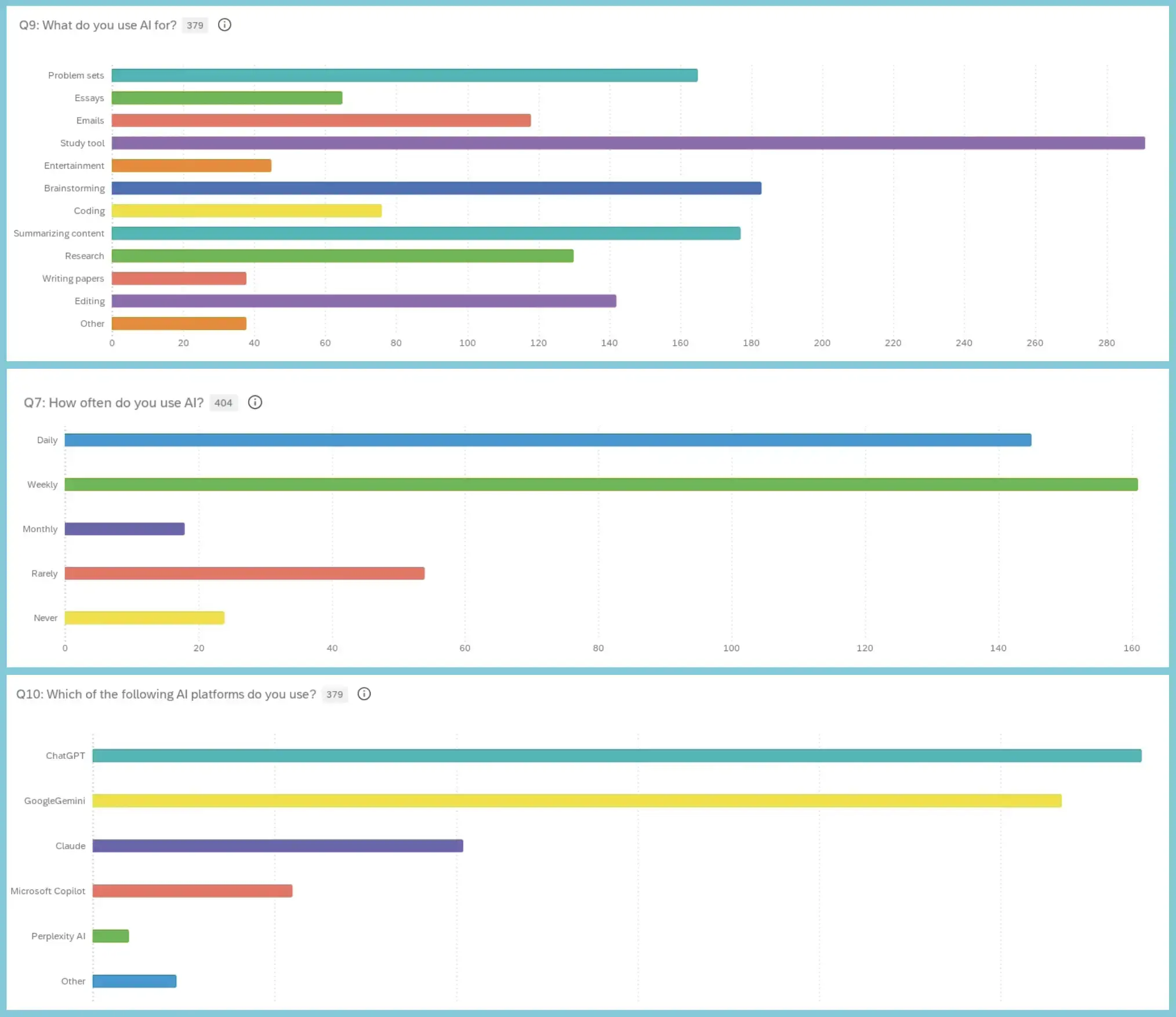
36% of respondents report using AI daily. 76% report using it at least weekly. 88% utilize free or provided AI, with 76% using ChatGPT and 70% using Gemini. Many students report using multiple different platforms: Microsoft Copilot, Claude, Grok, Magisterium and more made appearances.
The insight available on how exactly students utilize these services was especially intriguing. 77% of students use AI as a “study tool,” which fits in with the patterns of use that can be seen around campus: using AI to make study guides, flashcards or practice exams, asking it clarification questions, making it check over work or having it summarize assigned reading. 48% use it to brainstorm and 44% use it to solve problem sets. Less popular but still prominent uses include email writing (31%) and coding (20%). Interestingly, only 17% of students said they used AI for help with essays. This might be an effect of the heavy push from teachers and professors that outsourcing personal writing to generative AI is a punishable act of plagiarism. It might also be a trained behavioral response for students to answer any question about whether they used AI to write a paper with a “no.” Although members of classes 2026 through 2030 were asked for their input — the survey was sent out near the end of spring semester and sent again early this term — a plurality (46%) of all respondents were actually members of the class of 2030, meaning that they completed the questionnaire after just a few weeks on campus. Their high rates of AI usage indicate that the technology has already trickled its way down to the K-12 level enough to shape the learning of Notre Dame’s newest students.
Respondents also shared a variety of student-specific concerns about artificial intelligence. In addition to the numerous complaints about the environment, the job market and the consolidation of power, the responses indicate a real distaste toward what AI has already done to education. “I fear that I will fall behind my peers who abuse AI,” commented one 2030 student. “The only way to get a good grade in certain classes is to use AI,” reported another. The latter student recommended more lenient grading for problem sets so that undergraduates no longer feel as if ChatGPT or Gemini are the only paths to success. Multiple students specifically reported fearing that professors will believe they used AI and report them for plagiarism when they did not actually use it. Another frequent complaint is that students may be misled by it and end up with inaccurate information, with one respondent simply saying that they were afraid of “it giving me the wrong answer.”
There’s also a general sense that AI has moved too fast. “People are too taken in by it,” reported one student. Another reported being concerned about “the way it permeates everything — from word counters to search browsers — and how it continues to grow dangerously involved in everyday life.” These anxieties are substantially reflected in students’ response to the question about how AI use should be limited in the classroom. There are certainly a few techno-optimists out there (“It should be more lenient than most due to AI’s usefulness as a tool”) as well as techno-realists (“I believe that we should be taught to use AI ethically instead of being instructed not to use it at all because once AI is out there, it is not going to ever fully go away”). But the majority of responses to the query recommend stricter AI classroom guidelines. While students generally believe AI can and should be used as a tool, they don’t want it doing substantial work for them or others. The greatest point of emphasis is again on writing. “You absolutely should not be able to have it write the essay for you,” one anonymous 2027 student asserted. “It should be strict to the extent that that does not happen.” The word “strict” was used in 89 separate responses.
By far the most pervasive undergraduate concern about AI at Notre Dame is that it will rob people of their ability to think deeply and analytically: that their own AI usage has already taken something away from them. This is not a feeling limited to the 6% of respondents who never use AI, although those students do report the most significant apprehension over the environment, privacy and militarization. In fact, it appears that daily and weekly users may be the most anxious about the loss of the human mind. They are genuinely worried about whether or not the creative and cognitive skills of themselves, their young, AI-saturated peers and society as a whole will be able to survive.
Amongst the reported fears:
1. “People stop thinking.” A weekly user.
2. “That people will lose their ability to think for themselves.” A daily user.
3. “I fear that I will not be able to do basic things because I have become dependent on AI.” A weekly user.
4. “I feel like kids in middle and high school don't see the need to learn things like algebra or writing, which I grew up viewing as fundamental skills.” A daily user.
5. “I fear that people will become less smart and motivated if they don't use it within reason.” A daily user.
6. “That it will lead to cognitive offloading.” A daily user who utilizes four different AI platforms.
7. “I have the fear of semantic ablation and it hindering my critical thinking.” A weekly user.
8. “It becomes too good and humans won't have to think or work anymore.” A weekly user.
9. “I fear that AI will inhibit my learning development, stifle my creativity, and discourage reaching out to real people for questions. It has the potential to turn my education from an intellectual and spiritual journey into a menial set of tasks to complete.” An AI abstainer.
The survey responses collected by Scholastic indicate that Notre Dame students, despite what their professors may worry and what their frequent AI habits may suggest, do not actually want to throw their human intelligence and liberal arts education aside in favor of a magic computer tool that can do their homework for them. They are facing a difficult choice — and if everyone else is jumping off the cliff and getting a high A for doing so, why shouldn’t they jump too? They are excited about some of the possibilities and shortcuts of artificial intelligence, but that does not mean they can be labeled en masse as part of the generation “destroying” education through AI use. In fact, they seem to value thinking for the sake of thinking more than ever before. Perhaps that’s because we never before had to fear the loss of it.
The administration’s efforts to bridge the gap between ethics and AI are admirable, but it appears that it is Notre Dame students who truly sit in the space between. Their personal lives and reflections indicate that AI can be both routinely useful and quietly, destructive to the mind and heart. It illustrates that they too desire guardrails, despite believing that blanket bans may be impractical, and they are aware that their use of AI does not exist in a vacuum. More than anything, they want to stay human. It is the same goal put forth by “Team Humanity” Sam Altman and the same fundamental principle behind Leo XIV’s “Magnifica humanitas” — “Magnificent Humanity.”
We can hope that AI evolves in this direction. It’s certainly evolving nonetheless; in his Sept. 14 remarks about slowing the frontier, Altman noted with pride that “progress has been rapid and will continue to be.” We at Notre Dame must work to ensure that it evolves in this direction; that it is used to help those in need, that it makes innovative new solutions possible, that it can coexist with the human soul. People on campus can set out to do this as members of faith ethics groups or AI initiative participants. But they can also shape AI-era society simply by living as conscientious individuals and professionals sufficiently equipped to handle difficult questions. If there is one thing the survey results demonstrate, it’s that Notre Dame students will not and should not go blindly into this new world. We understand the cost.
It’s not just Father Dowd who believes that ND has a role to play in this transition. Caden Chuang, for one, believes that his Fighting Irish peers could be integral to the development of moral and reasonable artificial intelligence. “Notre Dame is well positioned to educate the people who will build and govern AI because students here receive a strong ethical education. My greatest concern is that people will mindlessly build AI systems without considering whom they affect or whether they should exist,” he told Scholastic. “Notre Dame encourages us to confront those questions alongside the technical ones.”
Those questions will only multiply, and AI will only continue to advance. These are the givens of the future. The rest is up to us, if we want it to be.