 "
"
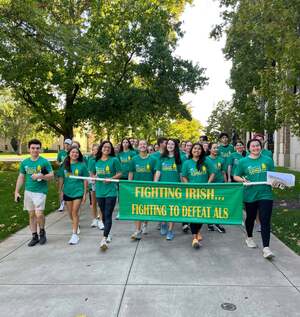
The Notre Dame Neuroscience Club held the 9th annual ALS Walk on the morning of Oct. 6, raising $2,765 for patients afflicted with ALS and their caregivers in the Notre Dame and St. Joseph County communities. ALS (Amyotrophic Lateral Sclerosis) “is a progressive and fatal neurodegenerative disease that impacts nerve cells in the brain and spinal cord” and results in the brain's loss of ability to “to initiate and control muscle movement,” explained Mackenzie Kelleher, Neuroscience Club ALS Walk co-chair.
The event began at the Jordan Hall of Science. Before the walk, students from all majors and members of the ND community heard from Colleen Kessler, daughter of former university pilot Bud O’Toole. O’Toole passed away on Aug. 23, 2023, after living with ALS for 10 years. She shared her father’s story and the impact that it had on her family, emphasizing the pain and helplessness she felt while watching someone she loved suffer through a disease with no cure. Colleen recalled that although her father was suffering, “he never complained” and additionally emphasized the value of appreciating every day and practicing gratitude. Fr. Gabe Griggs, C.S.C., led everyone in prayer and then the walk began. Participants walked past the Notre Dame Stadium, across South Quad and to the Grotto where the names of those in the Notre Dame community who have passed away due to ALS were read out. After prayer and reflection, the walk continued behind the Golden Dome, across North Quad and back to Jordan Hall of Science where it concluded. Kelleher underscored that “it is imperative that we raise awareness for ALS to shed light on the hardships this disease brings upon patients and their families.”
“By bringing in speakers who have personally been impacted by ALS to share their stories, the Notre Dame community grows in their understanding, empathy, and ability to be advocates. Additionally, by rallying a force of students, faculty and community members from St. Joseph County, we spread the message that patients and families are not alone in their fights against ALS. Especially in the rare disease space, having a community to lean on for support is invaluable. Despite the wealth of new scientific understanding regarding the underlying biology of ALS, there is still no cure. The best way to move the needle forward in this regard is by continuing to elevate the voices of patients and patient families while raising money and awareness for research for a cure.”
The Neuroscience Club continues to advocate for and support ongoing research on ALS, hoping to contribute to the discovery of a cure.