 "
Revisiting Notre Dame's First Four-Year Co-ed Class at the 50 Year Mark
Sally Benson ’76 still remembers the first time she walked into a classroom at Notre Dame. It was her junior year — she’d been at Saint Mary’s before that — and she was entering an engineering class full of men.
She had to cross the room to sit down at the only available seat, which was in the front row. As she walked, she recalled hearing “catcalls and shenanigans, whispers and whistles and stuff.” Embarrassed, she sat down, but she quickly realized this was a chance to prove she belonged right where she was.
“I thought, ‘It’s now or never, Sally,’” Benson said.
She stood up. Turned around. And looked her classmates in the eyes as she said, “Thank you for that warm welcome. Knowing how nervous I would probably be coming in here, I really appreciate that.”
A stunned silence fell over the room. Then, applause.
“We were good buddies from then on,” she said.
Benson’s anecdote brings to life the mixed bag that was coeducation at Notre Dame between 1972, the year the university began directly admitting female undergraduates, and 1976, her graduation year. It was characterized by great challenges and even greater successes for those first women who helped shape the university into what it is today.
What we leave out
A piece of Notre Dame’s history that is often forgotten in discussions of the first female undergraduates is the women themselves — many of them religious sisters — who earned degrees from the university before 1972.
Notre Dame’s first female students were graduate students — six Sisters of the Holy Cross from Saint Mary’s — during the 1916-17 school year. Their education at Notre Dame came after the decision by a Notre Dame faculty committee under then-president Rev. John Cavanaugh, C.S.C., to begin conferring master’s degrees to Sisters and Saint Mary’s students.
In the summer of 1918, largely thanks to director of studies Rev. Matthew Schumacher, C.S.C., the collaboration between the two schools grew with the opening of a summer school open to priests, brothers and sisters from all orders (not just Holy Cross) and to male and female laypeople. The Summer School, which was the precursor to Notre Dame’s fully coeducational Graduate School, was designed so that all students could earn an advanced degree in three summers and an undergraduate degree in four. It was staffed by Notre Dame faculty, and women were included on the faculty by 1921.
Not long after, some women from the Summer School began studying at Notre Dame during the academic year as well. 1922 saw the first cohort of lay and religious women — five in total — to earn bachelor’s degrees from the university. And that number continued to grow.
So while the women in the class of 1976 have an unquestionably unique place in Notre Dame history, they were preceded by scores of women who, in total, earned over 4,600 degrees from the university (most of them graduate degrees) before official coeducation began in the fall of 1972.
In the words of Beverly Winterscheid ’76, “We stand on the shoulders of those who came before us.”
To merge or not to merge
The 1972 decision to admit women to Notre Dame came on the heels of a failed merger between Notre Dame and Saint Mary’s College. Prior to that, in the mid-1960s, Notre Dame and Saint Mary’s had started a “co-exchange program,” which allowed students from both schools to take classes together on both campuses.
“That was kind of a five-year time horizon, and the assumption was that eventually it would lead to some sort of an amalgamation of institutions,” Professor Kathleen Sprows Cummings, the John A. O’Brien Collegiate Professor of American Studies and History at Notre Dame, said. “What’s really important to understand is that the model was [to] have these two institutions come together to create something new.”
Toward the end of those five years, however, provost Rev. James Burtchaell, C.S.C., and others began to discuss the possibility of Notre Dame absorbing Saint Mary’s completely via a merger. This was a possibility which the leadership at Saint Mary’s was not fond of, as they worried the school might lose its distinct identity as a women’s college.
In the controversial words of president Rev. Theodore Hesburgh, C.S.C., “In the end, [the Sisters of the Holy Cross] wanted to marry us but not take our name or live with us.”
Discussions broke down between the two schools after that, according to Cummings, and Notre Dame began looking at other women’s colleges with which to potentially merge, though nothing came from that search. On Nov. 30, 1971, the merger’s failure was officially announced in a joint statement, and along with it, Notre Dame’s intention to directly admit female undergraduates in the fall of 1972.
While this saga was playing out, seniors in high school such as Benson, Winterscheid, Debi Dell ’76 and Diana Bourke ’76 were applying to a combined Notre Dame and Saint Mary’s. After the merger fell through, they had to decide which school they would attend. Benson chose Saint Mary’s, while Dell, Winterscheid and Bourke chose Notre Dame.
These women felt the rushed nature of Notre Dame’s preparation for the incoming female undergraduates soon after they moved in.
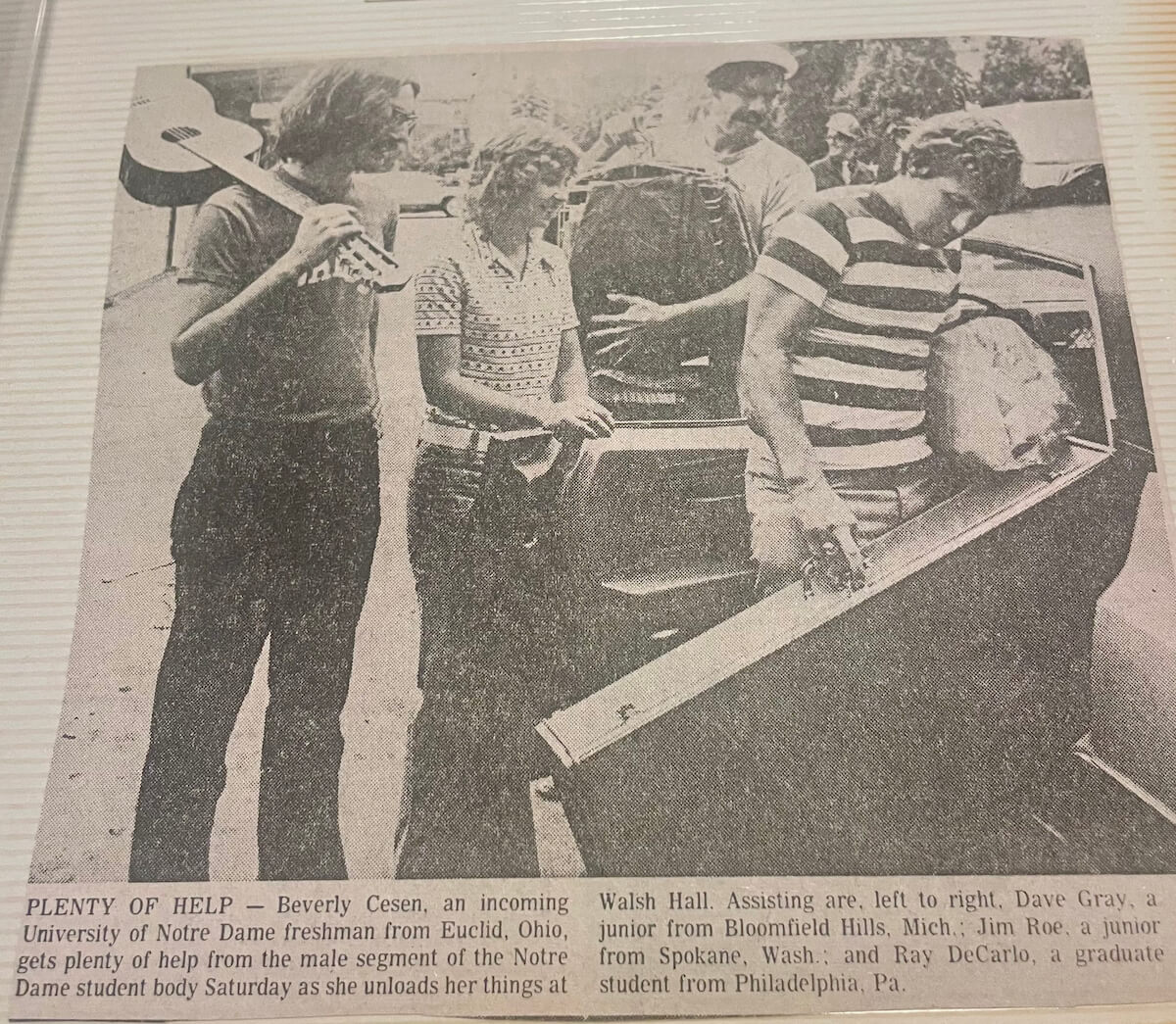
“They made the decision so quick to not merge with St. Mary’s that Notre Dame didn’t have a lot of time to get ready for the women, so that was a challenge,” said Dell, author of the book “Objects in the Rearview Mirror” about coeducation at Notre Dame. “The bathrooms weren't even ready. There were still urinals in our bathrooms in Walsh.”
A successful merger would have also allowed for the ratio of men to women at Notre Dame to be much more equal in the fall of 1972, at about 3-to-1. Instead, the 1972-73 school year saw a ratio of almost 17-to-1. This disparity also translated to the faculty level.
“There were very few female professors at Notre Dame when we were there. When we first started, there were two,” Dell said.
The dearth of female professors, combined with the fact that the rectors of most female dorms were religious sisters, left Dell feeling like something was missing that first year.
“You didn’t even have a role model from a professional woman's perspective, so that was kind of challenging in that we [were] really breaking a glass ceiling at Notre Dame by coming in, but they weren't ready for us,” she said.
In and out of the classroom
Though the female freshmen in the fall of 1972 faced a tall order in assimilating themselves into what had largely been an all-male institution up until that point, many of them weren’t as daunted as one might expect.
Winterscheid, in fact, was “Totally psyched. Are you kidding? It was totally wonderful.” She recalled being especially excited to have more independence from her parents and to figure out who she wanted to be now that she was in college.
Of course, she was also a bit shocked when she realized how many of the men (many of whom had come from all-boys schools) hadn’t been around women very frequently. As a result, they pulled a number of stunts that would be less than acceptable on a college campus today.
Winterscheid, Dell and Benson all recalled the scorecards their male classmates would hold up to numerically rate women as they passed by in the dining halls.
“You know, that’s disgusting to be so objectified,” Winterscheid said, though she recalled not taking their “bizarre” ratings too seriously.
It was even more bizarre, she thought, to work on group projects with men who weren’t used to being with women in an academic setting.

Bourke had a similar experience, saying, “The fact that you were the only woman in every class, you were asked your opinion, no matter what the opinion was.”
That was one thing all of the class of 1976 women had to contend with: often being the only woman in the room, just like Benson was on her first day of junior year. Though it could be intimidating at first, this dynamic often benefited the women in the end.
“I really think that it was great to go to Notre Dame in the first year [and] to have those experiences because I totally knew how to work with men,” Winterscheid said. She went on to earn her Ph.D. in business and spend 20 years in the corporate world, something she believes was much easier because she had been in the first class of women at Notre Dame.
Dell, who spent 38 years working at IBM, echoed this sentiment, saying, “You’d already experienced what it was like to be the only female.”
In addition to their male counterparts, the women in the class of 1976 were also met with mixed reactions from faculty.
“There were faculty who were not happy about women being at Notre Dame,” Dell recalled.
Many others, however, were eager to help the women feel as comfortable as possible at their new school. Benson, as a transfer student (and, not to mention, the first female undergraduate civil engineering major), faced a unique set of challenges as she tried to piece together her curriculum so she could graduate on time. Engineering professor Jerry Marley turned out to be a valuable resource for her during her time at Notre Dame, both for figuring out the classes she needed to take and for deciding what she would do with her engineering degree.
“Dr. Marley and the staff were really helpful. That was a great opportunity to have people that were interested in your success in the classroom, but they were [also] interested in what you were gonna do later,” Benson said.
Dell felt similarly about select faculty at Notre Dame creating a welcoming environment for her and her classmates.
“I was lucky enough to have several faculty members, as well as Father Hesburgh and Emil T. Hofman,” the dean of the Freshman Year of Studies, “who made sure that I wasn’t going to leave Notre Dame,” she said.
Bourke also forged connections with her professors early on, including economics professors William Davisson and Frank Bonello. She believed that benefits such as this and the opportunities they provided outweighed the challenges of being so outnumbered by men her freshman year.
“It was a very caring environment. It was an environment that challenged me as a woman to feel like an equal,” she said.
Moreover, Bourke acknowledged she had been able to do things at Notre Dame she wouldn’t have done at any other university. Specifically, she recalled getting to work with the aforementioned professors on the research for a Sloan Foundation grant in the summer of 1973.
“There was this kind of focus on the women that were at Notre Dame,” she said, “and when opportunities came up, they were offered to women if you were willing to take them.”

Changes over time
As the class of 1976 women continued their college careers, many of them noticed the university changing to better accommodate them. For one, more women were being admitted every year, which helped to fix the incredibly lopsided ratio they had experienced in their first year, when there had been only 325 total female undergraduates on the first day of classes.
“We were starting to get critical mass, and so, you know, we were becoming a force to be reckoned with,” Winterscheid said. Though this change also meant that many of the women had to move dorms each year, they tended not to mind, as a new dorm meant they got to meet more of their female classmates.
Additionally, with more women finding their place at Notre Dame came fewer men participating in such offensive activities as rating women in the dining halls, a welcomed change for women who were simply trying to get their education and feel comfortable doing so. The university also began hiring more female professors, albeit slowly, and began to focus more on women’s athletics.
“All aspects really did improve,” Dell said.
A class united
In June, Dell, Winterscheid and Benson all returned to Notre Dame for their 50th reunion. It was a special one, to be sure: A couple of weeks earlier, their class had been notified that they would be receiving the Sorin Award, which honors “a graduate or graduates who have rendered distinguished service to the University.”
Dell, who became class president in 2005, played a large role in planning and executing the reunion along with the other class officers, Mark Nishan ’76, Steve Klug ’76 and Bob Quakenbush ’76. She was incredibly happy to receive the news.
“I think we were shocked because no class has ever received it,” Dell said.
The class of 1976 broke another record at their 50th reunion by making it the most highly attended reunion by alumni of any class at 548 attendees.
“I’m still kind of on a reunion high. It was phenomenal,” Benson said. Since she began college at Saint Mary’s and her civil engineering classes were mostly composed of men, she has made many of her female Notre Dame friends through reunions such as these. During the reunion, she and many of her engineering classmates were also able to reunite with their former professor Marley shortly before his passing later that month.
The class of 1976 has also put together a number of “mini-reunions” over the years. Many of the women used to gather for lunch with Father Hesburgh on his birthday each year, and classmates also come to the garden they donated by Saint Mary’s Lake to release butterflies in honor of their deceased classmates. They also try to meet up for football games in the fall.
Dell believes that, in large part due to these efforts, her class has become more cohesive over time. Bourke agrees.
“I think everyone in our class lived through the most significant change that Notre Dame ever had,” Bourke said, “and I think that that made our class stronger than any other class.”