<?xml version="1.0" encoding="UTF-8"?>
<?xml-stylesheet type="text/xsl" href="/stylesheets/feed.atom.xml" media="screen"?>
<feed xml:lang="en-US" xmlns="http://www.w3.org/2005/Atom">
  <id>tag:scholastic.nd.edu,2005:/issues</id>
  <link rel="alternate" type="text/html" href="https://scholastic.nd.edu"/>
  <link rel="self" type="application/atom+xml" href="https://scholastic.nd.edu/issues.atom"/>
  <id>tag:scholastic.nd.edu,2005:/latest</id>
  <title>Scholastic | Issues</title>
  <updated>2026-10-07T14:32:00-04:00</updated>
  <link rel="alternate" type="text/html" href="https://scholastic.nd.edu/"/>
  <link rel="self" type="application/atom+xml" href="https://scholastic.nd.edu//issues.atom"/>
  <subtitle>Scholastic is the student news magazine of the University of Notre Dame. Founded in 1867, Scholastic is the United States’ oldest continuously published collegiate news magazine.</subtitle>
  <entry>
    <id>tag:scholastic.nd.edu,2005:News/185975</id>
    <published>2026-10-07T14:32:00-04:00</published>
    <updated>2026-10-04T19:41:20-04:00</updated>
    <link rel="alternate" type="text/html" href="https://scholastic.nd.edu/issues/ai-at-notre-dame/"/>
    <title>AI at Notre Dame</title>
    <summary type="text">
      <![CDATA[What do we owe our own work?]]>
    </summary>
    <content type="html">
      <![CDATA[<figure class="image image-right"><img src="https://scholastic.nd.edu/assets/681341/fullsize/ai_on_chalkboard.jpg" alt="Professor pointing to AI on chalkboard, illustration" width="2043" height="2362">
<figcaption>Art by Ashlynne Bracamonte</figcaption>
</figure>
<p>Three years ago, asking a website to write your essay sounded like science fiction. Today, it takes 15 seconds and an email account. As tools like ChatGPT and Google Gemini become fixtures of student life — Notre Dame students 18 and older can access Gemini and Google NotebookLM through their university accounts — professors are now, more than ever, rethinking how assignments should be built, how integrity will be protected and how the Honor Code will be applied to a technology that evolves by the day.</p>
<p>The most visible change due to this advancement is in the assignments themselves. Work that once could be completed entirely online is increasingly moving back to paper, with some professors now requiring students to handwrite at least part of what they submit for grading. Alongside that shift, faculty now lean harder on detection software. Particularly, plagiarism and AI-checking tools like Turnitin are now routinely used to screen student work as it comes in, creating a kind of arms race between the tools students might misuse and the ones instructors use to catch that misuse. Other adaptations add to the picture, as more in-class and oral exercises emerge, all serving as a deterrent for this inappropriate technology use. Many students are aware of this reality; when asked about her thoughts on AI usage in the classroom, a Notre Dame sophomore said, “AI can be beneficial to a point. There’s a line that you can cross, and once you cross that line, then you’re hurting yourself more than you’re helping yourself.”</p>
<p>Yet, faculty are candid about a hard truth: There is no foolproof way to guarantee a student won’t use AI. Handwriting work and detection software lower the odds, but they can’t eliminate them. Because of that, many professors turn from policing to persuasion. During syllabus week especially, many instructors will make a pointed case against leaning on AI for the wrong tasks. Specifically, using a chatbot to grind through calculus homework or to complete online assignments for a language class, they argue, offers no real learning benefit — it simply outsources the practice that is needed to succeed. They will further argue that the consequences will show up later — in person. If a student were to entirely rely on AI for daily work going into a closed-book setting like midterms, they are practically setting themselves up for failure. Framed this way, professors make a convincing case that integrity when it comes to AI becomes a matter of self-interest as much as abiding by the rules.</p>
<p>This doesn’t mean that professors don’t realize that AI can be a helpful tool in the classroom, however. A Notre Dame professor believes that AI “can be a helpful study guide tool for students only if it doesn’t replace their learning.” With AI’s ability to explain difficult concepts, consolidate study terms into a study guide and create practice questions, the extent to which the technology is utilized ultimately determines what students get out of it. It’s difficult for students to put these boundaries into practice, however, meaning that AI’s benefits might come to pass only in theory.</p>
<p>The importance of not replacing your work and learning with AI ultimately rests on a foundation older than any AI tools. At the beginning of every year, Notre Dame students sign the Honor Code pledge, taking on the responsibility to abide by principles of intellectual integrity and thereby promising not to participate in or tolerate academic dishonesty. The code was written long before generative AI, but its core principle — never representing others’ work as your own — extends to this technology almost seamlessly.</p>
<p>The University of Notre Dame made that extension explicit in its August 2023 Generative AI Policy for Students, which states plainly that “representing work that you did not produce as your own, including work generated or materially modified by AI, constitutes academic dishonesty.” Crucially, the standard is instructor-centered, meaning that when a violation occurs to an instructor’s articulated policy or used it to complete coursework in a way not expressly permitted by the faculty member, it will be considered a violation of the Honor Code. Hence, this is why the rules and standards of whether generative AI is permitted in classrooms differ from one professor to another.</p>
<p>As these tools become increasingly more common, the burden shifts toward clear communication and student integrity, as both sides work together to create a studious environment that ensures fairness and prestige standards. The university’s own framing captures the goal best: AI should supplement a student’s education, not replace it.</p>]]>
    </content>
    <link rel="enclosure" type="image/jpeg" href="https://scholastic.nd.edu/assets/681341/ai_on_chalkboard.jpg" title="Professor pointing to AI on chalkboard, illustration"/>
    <author>
      <name>Audrey Chen and Joanna Luan</name>
    </author>
  </entry>
  <entry>
    <id>tag:scholastic.nd.edu,2005:News/185863</id>
    <published>2026-10-07T14:31:00-04:00</published>
    <updated>2026-09-30T14:58:02-04:00</updated>
    <link rel="alternate" type="text/html" href="https://scholastic.nd.edu/issues/data-centers-everywhere/"/>
    <title>Data Centers Everywhere</title>
    <summary type="text">
      <![CDATA[Growing up in Northern Virginia meant reaping the benefits of proximity to our nation’s capital. From field trips to the Smithsonian museums, walks across the National Mall and many hours spent on the Metro (objectively the best public transportation system on the East Coast), I was spoiled from an…]]>
    </summary>
    <content type="html">
      <![CDATA[<p>Growing up in Northern Virginia meant reaping the benefits of proximity to our nation’s capital. From field trips to the Smithsonian museums, walks across the National Mall and many hours spent on the Metro (objectively the best public transportation system on the East Coast), I was spoiled from an early age. People forget, however, that driving out of the city offers its own benefits.</p>
<p>My favorite outside-of-DC stop was always Manassas, Virginia. Manassas is home to the historic Battle of Bull Run battlefields. My neighbor and I would drive through the battlefields on our way to summer camp at a farm in Manassas. I’d stare out the window at the cannons littered across open fields, the wooden fences leaning with time.</p>
<p>Now? There’s a data center right next door. The farm my neighbor and I used to spend hot summer days at is being replaced by computer systems enclosed by sterile white buildings. Right next to where Robert E. Lee faced the Union Army.</p>
<p>You can imagine my non-surprise when I found out about the proposed data center projects around South Bend. Because what goes better with tailgates and Touchdown Jesus than fiber-optic cables and AI systems? But on a serious note, the Northern Indiana data centers — and data centers in general — are more than just road trip eyesores.</p>
<p>Sophomore Katherine Spiller spent her summer doing research and fieldwork in the St. Joseph County Kettle Lakes Corridor, just west of South Bend. The area is home to a sensitive sphagnum bog habitat, containing many endangered and rare species. A proposed data center project would pose huge environmental threats to such a rich habitat. Already, some of the lakes are drying up, and the massive amounts of water used to power data centers would cause even more drainage in the kettle lakes. Without water — or a home — the species that live in the lakes would cease to exist.</p>
<p>“I believe hearing from those who see what the Corridor experiences ... is key to touching hearts and enacting positive change,” Spiller said. She asserted that over half of the people she interviewed brought up concerns about the effect of the data center on the local community, something that should compel tech companies and bystanders alike to step back and consider what they are supporting.</p>
<p>We live in a next-step world where society is constantly coming up with ways to optimize and streamline our daily lives, and data centers fit into this future-focused mindset. But they’re almost counterproductive to the things that truly matter. In Virginia, a historical site backdropped by mass innovation provides a scary juxtaposition between past and future. In Indiana, a local ecosystem is slowly being sucked away by the hand of AI. Sure, ChatGPT is great and all, but is this really what we want? Is this really what it means to live in 2026?</p>]]>
    </content>
    <link rel="enclosure" type="image/webp" href="https://scholastic.nd.edu/assets/680553/location_image_fallback.webp" title="data centers"/>
    <author>
      <name>Ellie Cooney</name>
    </author>
  </entry>
  <entry>
    <id>tag:scholastic.nd.edu,2005:News/185902</id>
    <published>2026-10-07T14:31:00-04:00</published>
    <updated>2026-09-30T14:31:51-04:00</updated>
    <link rel="alternate" type="text/html" href="https://scholastic.nd.edu/issues/what-chatgpt-can-and-cant-handle/"/>
    <title>What ChatGPT Can and Can't Handle</title>
    <summary type="text">
      <![CDATA[Yeah, This Is Going to Chat: 1. Petition to bring back Taco Bell I plan to unleash a small army of my AI bots onto the emails of StuGov, SUB, the LaFun Building Manager and Father Bob. My bots will petition these higher powers for a gift to the student population:…]]>
    </summary>
    <content type="html">
      <![CDATA[<h2>Yeah, This Is Going to Chat:</h2>
<p><strong>1. Petition to bring back Taco Bell</strong></p>
<p>I plan to unleash a small army of my AI bots onto the emails of StuGov, SUB, the LaFun Building Manager and Father Bob. My bots will petition these higher powers for a gift to the student population: the return of Taco Bell to the underbelly of LaFun. With success, I will welcome back the prodigal son and enjoy a Crunchwrap Supreme and some cinnabuns. With failure, it may be time to test out the pizza machine in the lobby of NDH.</p>

<p><strong>2. Marriage Pact Questionnaire</strong></p>
<p>Marriage Pact season is almost upon us. I have no problem handing over some personal data to Gemini to craft up the best combination of responses to the Marriage Pact questionnaire to make sure that I get matched with my campus crush.</p>

<p><strong>3. Foot Traffic and LaFun barbershop</strong></p>
<p>Claude Pro Max20 will pay for itself once I optimize my LaFun Barbershop x Minimal Foot Traffic algorithm. I really need to get my hair cut, but there is some sort of stigma against female students going to the LaFun barbershop. The establishment is actually officially named University Hair Stylists, which I find to be quite gender neutral, and I’m sorry, but it would just be so convenient.</p>
<h3> </h3>
<h2>What Chat Can't Handle:</h2>
<p><strong>1. Moreau Reflections</strong></p>
<p>Chat doesn’t know what it’s like to have the last registration time as a first year. There is something incredibly bonding about an 8 a.m. Friday morning Moreau that really comes through in a reflection circle, and to Chat responses to “Who are you, really?” would be a true betrayal of peers.</p>

<p><strong>2. My Fizz Account</strong></p>
<p>You’ve heard of “third spaces,” but have you heard of “fourth spaces?” As I climb the ranks of the Fizz leaderboard, I see myself joining a great tradition of comedic scholars at Notre Dame. It’s this kind of fourth space that is really great if you want to let your jokes bomb anonymously. If you want to attach your name in print, though, you can always write for the <em>Scholastic</em> humor section.</p>

<p><strong>3. Ranking All 25 Murphy’s Ice Cream Flavors</strong></p>
<p>There are some instances where you can only trust yourself.</p>]]>
    </content>
    <link rel="enclosure" type="image/webp" href="https://scholastic.nd.edu/assets/680773/edited_photo.webp" title="ChatGPT search"/>
    <author>
      <name>Mary Katherine Carroll</name>
    </author>
  </entry>
  <entry>
    <id>tag:scholastic.nd.edu,2005:News/185961</id>
    <published>2026-10-07T14:31:00-04:00</published>
    <updated>2026-10-04T17:56:52-04:00</updated>
    <link rel="alternate" type="text/html" href="https://scholastic.nd.edu/issues/is-ai-good-for-humanity/"/>
    <title>Is AI Good for Humanity?</title>
    <summary type="text">
      <![CDATA[What are the odds that AI kills the whole of humanity? Apparently greater than 10%, at least according to a top researcher at Anthropic. Who could have predicted we would reach this point? If someone went back in time to four years ago, around the time ChatGPT became available to the public, and told…]]>
    </summary>
    <content type="html">
      <![CDATA[<p>What are the odds that AI kills the whole of humanity? Apparently greater than 10%, at least according to a top researcher at Anthropic. Who could have predicted we would reach this point? If someone went back in time to four years ago, around the time ChatGPT became available to the public, and told people that AI would pose a credible risk to the viability of humanity by the end of the decade, he would have been reasonably called crazy! How we decide to engage, control, and develop AI in the present moment will have potentially indelible consequences that will ripple out for years to come.</p>
<p>Some may understandably argue that AI is somehow a suspect force that we do not fully understand, and therefore argue for the adoption of a sort of luddite approach. Most feel generally concerned at the growing presence of AI. Indeed, the prospect of AI destroying humanity does not make me particularly eager to open Claude to look up recipes for cookies I’ll never actually bake. Despite the trepidation most of us feel towards AI, it is imperative to maintain a balanced approach towards this critical technology — one share of prudence, one share of optimism. For as much as AI may be a threat to human dignity, it has tremendous potential to uplift humanity, especially the vulnerable and marginalized.</p>
<p>AI should be properly understood as a tool. Progress can be called authentic only when it facilitates the social and personal development in a society. Economic growth, efficiency and technological innovation, while beneficial in some contexts, are vain if they do not contribute to authentic human flourishing. We should feel alarmed at the prospect of rapid, untethered AI development. Unbridled AI development for the sake of an international arms race, economic gain and so on displaces the vision of technology serving humanity, endangering the promotion of human dignity.</p>
<p>Despite these genuine risks and concerns, it is important to maintain a sense of optimism. Prudence must not devolve into demonizing a technology that stands to potentially uplift an unnumbered amount of lives. Take the realm of healthcare, for example. AI is already being implemented in medical scanning and imaging, flagging malignant tumors and irregularities that doctors may have otherwise missed. AI is also playing a crucial role in hastening drug and vaccine development and was even used in the development of the COVID-19 vaccine. Furthermore, AI is being used to power virtual assistants that can triage symptoms and reduce a burden in the process of seeking the proper medical care — a boon particularly helpful for those living in rural areas, for example, that lack adequate healthcare access. AI in the realm of healthcare is just one example of how this technology may uplift and protect human dignity, and a myriad of other realms. I could devote many pages to detailing the potential benefits of AI to humanity.</p>
<p>It is important, therefore, that we take a proactive approach to AI. Being a true optimist is believing that good things can happen, not that they necessarily will happen. This implies an obligation: It is incumbent upon all of us to understand the potential benefits and risks of AI and to earnestly advocate for a human-centered development process. Don’t restrain yourself from being mad, scared and excited at the same time. Write to your representatives in Congress, march in the streets, daydream about technology making the world a better place. Whatever you do, don’t keep on with the status quo. Our collective fate as a species is at stake.</p>]]>
    </content>
    <link rel="enclosure" type="image/webp" href="https://scholastic.nd.edu/assets/681299/mohamed_hassan_machine_learning_8980162.webp" title="illustration representing artificial intelligence and machine learning"/>
    <author>
      <name>Bob Koehne</name>
    </author>
  </entry>
  <entry>
    <id>tag:scholastic.nd.edu,2005:News/185964</id>
    <published>2026-10-07T14:31:00-04:00</published>
    <updated>2026-10-04T18:24:12-04:00</updated>
    <link rel="alternate" type="text/html" href="https://scholastic.nd.edu/issues/a-big-burden/"/>
    <title>A Big Burden</title>
    <summary type="text">
      <![CDATA[As I was preparing for college, I decided to invest in a new MacBook Air and an iPad paired with the latest Apple Pencil, following the recommendations of many of my friends. They all recommended it as the best way to take notes, study and organize everything I would need for my courses. I quickly…]]>
    </summary>
    <content type="html">
      <![CDATA[<p>As I was preparing for college, I decided to invest in a new MacBook Air and an iPad paired with the latest Apple Pencil, following the recommendations of many of my friends. They all recommended it as the best way to take notes, study and organize everything I would need for my courses. I quickly discovered that they were right. I could effortlessly switch between different writing tools and change the color or transparency. I could create individual digital notebooks for each of my classes. I could easily annotate lecture slides and add my own notes. I also maintained a digital planner with pages that flipped just like a real one. The possibilities with this technology seemed endless. But the best part was how much lighter my bag became in comparison to my backpack in high school. I didn’t need to carry nearly as many supplies with me, because everything I could possibly need was conveniently stored on my devices.</p>
<p>As technology has continued to rapidly develop, it has greatly reshaped the learning environment. My generation has been at the forefront of this change, and we’ve had to constantly adapt. I remember when Chromebooks were introduced into the classroom, and soon after, it became an essential tool for teaching lessons and engaging in application activities. Almost all my assignments were completed and submitted through digital platforms by the time I was in high school. The change moved towards increasingly implementing technology, but now it seems like education is moving in the opposite direction.</p>
<p>Last year, to my surprise, I had a few classes where technology was limited. Some professors had specific rules about how to use technology and devices in class. I made adjustments to follow each of my professors' rules. However, this semester a majority of my classes have completely eliminated the use of technology by students during class time. An increasing number of my peers’ professors and my professors have banned technology entirely or significantly restricted its use in the classroom. I am forced to take most of my notes with pen and paper again. In addition, many of my professors require all of the readings to be printed out and annotated before class. I’ve had to reinvest in physical notebooks, pens, pencils, highlighters and the list goes on. While I carefully save my printing budget to last me through the year, my bag only grows heavier.</p>
<p>The burden of navigating technology policies, specific professors’ preferences and switching materials used for each class has only added to the anxiety I feel as I navigate new classes and professors. Every first day, “Welcome back” is wrangled with anxiety and a risky decision to pull out a device. It is unnecessarily complicated to ensure I have the supplies and readings I need each day and shuffle through endless papers in my folders. The struggle of planning my schedule around finding a working printer on campus and the patience to work with NDPrint just adds to that. With all the readings stuffed in my bag and notebooks stacked up, the heavy load in my bag continues to weigh me down as I navigate campus.</p>
<p>While professors often teach using technological devices and require students to use their devices to submit homework or as communication channels, students are not given the same freedom to use tools accessible to them to help them learn in the classroom. Oftentimes, educators will explain their reasons for not having devices in the classroom is to protect the learning environment. In my experience, completely banning electronics is only hurting my back and killing the trees. I understand there are benefits to not having technology in the classroom, but with opportune tasks, especially note-taking or accessing readings, technology can help students organize and use devices effectively for learning.</p>
<p>Students who have invested in the future of technology should not have to bear the burden of proving themselves responsible enough to use it in purposeful ways. Devices can take notes without being connected to the internet, notifications can be silenced and completely turned off, many note-taking devices can be laid flat and possible distractions created by devices can be eliminated in the classroom. We should all be able to take advantage of the opportunities technology offers. A meaningful compromise between educators and students could help everyone navigate the increasing prevalence of technology and lighten the unnecessary load students carry.</p>]]>
    </content>
    <link rel="enclosure" type="image/jpeg" href="https://scholastic.nd.edu/assets/681310/mlc_4825_david_richter_class_18.jpg" title="April 8, 2025; A student takes notes during a class in O'Shaughnessy Hall. (Photo by Michael Caterina/University of Notre Dame)"/>
    <author>
      <name>Grace Hunt</name>
    </author>
  </entry>
  <entry>
    <id>tag:scholastic.nd.edu,2005:News/185965</id>
    <published>2026-10-07T14:31:00-04:00</published>
    <updated>2026-10-04T18:36:35-04:00</updated>
    <link rel="alternate" type="text/html" href="https://scholastic.nd.edu/issues/a-better-prompt/"/>
    <title>A Better Prompt</title>
    <summary type="text">
      <![CDATA[The Answer to AI Might Be a Better Assignment]]>
    </summary>
    <content type="html">
      <![CDATA[<p>Rebecca Thornton, an economics professor in her second year at Notre Dame, still remembers a student who came to her upset. It was the student’s senior year; another professor had run her history essay through an AI detector, and the software had flagged it. She needed that class to graduate.</p>
<figure class="image image-right"><img src="https://scholastic.nd.edu/assets/681311/fullsize/thornton.jpg" alt="Professor Rebecca Thornton" width="444" height="458">
<figcaption>Professor Rebecca Thornton offers valuable insight into her experience with students using AI for academic work. Image courtesy of Notre Dame.</figcaption>
</figure>
<p>“I said, ‘Did you do this?’” recalled Thornton. “And she said, ‘Yes, I used AI for this.’”</p>
<p>Thornton wasn’t shocked. The student didn’t care much about the assignment, she said, so it was easy to see why she took the shortcut.</p>
<p>That student has plenty of company. A Lumina Foundation-Gallup survey released in April found 57% of U.S. college students use AI for coursework at least weekly, while about half say their schools discourage or prohibit it.</p>
<p>Notre Dame leaves AI policy up to each professor, an approach Thornton said makes her proud. She and Thomas Mustillo, an associate professor of politics, have used that freedom in very different ways.</p>
<p>Thornton is generally against students using AI. She compares AI-written papers to cheap flat-pack furniture.</p>
<p>“It looks like a pretty glossy veneer,” she said. “But if you push too hard on it ... you’ll destroy the table.”</p>
<p>In the writing course Thornton has taught for 20 years, students produce an original empirical paper. Last year, she set up a Google Doc for each student to watch their writing develop over the semester. When a draft looked AI-generated, she called the student in to talk about it.</p>
<p>Part of her objection is also personal. Thornton said she dislikes reading AI writing and would rather spend her time responding to students than to a robot.</p>
<figure class="image image-left"><img src="https://scholastic.nd.edu/assets/681312/fullsize/headshotsmsmall.jpg" alt="Professor Thomas Mustillo" width="600" height="375">
<figcaption>Professor Thomas Mustillo provides an alternate perspective about how he has implemented AI in the classroom. Image courtesy of Notre Dame.</figcaption>
</figure>
<p>Meanwhile, Mustillo has brought AI into his classroom, though it took time. At first, he said, the uncertainty around AI left him paralyzed. What moved him was an interview New York Times columnist Ezra Klein did with an executive at Anthropic, the company behind the chatbot Claude. The executive argued that what students need most is good taste and good judgment, two things AI can’t supply.</p>
<p>“I need to teach the students how to use the tool,” Mustillo said. “And then I have to teach them how to use good judgment.”</p>
<p>In his classes, that means working the way political scientists increasingly do. Researchers have long read party manifestos, where political parties lay out what they stand for, line by line and sorted the contents into categories. Journals in Mustillo’s field now publish guides on handing that first pass to AI.</p>
<p>His students do the same, then have to defend the results. Each one picks a party and a country and explains why. They sketch out how they plan to work and draw early conclusions, and Mustillo questions them at every step. If a conclusion doesn’t hold up, he sends the student back to read the manifesto.</p>
<p>“That’s my goal,” he said. “To get them to think about it.”</p>
<p>He admits the hardest part is still unsolved.</p>
<p>“How do you separate what the machine did from what the student did?” he said. “That’s the problem.”</p>
<p>That line gets harder to hold the more students rely on AI. A study of more than 95,000 undergraduates published in Science in May found 26% of daily AI users admitted cheating with it, compared with 7% of monthly users.</p>
<p>The two professors also read history differently. Thornton pointed to the telegraph, the telephone and the internet, each hailed as world-changing. Those technologies did change things, she said, but people kept coming back to the basics.</p>
<p>Mustillo sees AI as the next step in that same line of change, and a bigger one.</p>
<p>“There was the analog age, the digital age and now we’re entering a new age, the AI age,” he said. “I think it’s going to be transformative.”</p>
<p>Where the two professors meet is motivation. Students are less tempted to take shortcuts, Mustillo said, when the work means something to them. Thornton said it’s on her to make the material interesting enough that students don’t feel the need for AI.</p>
<p>“When my child lies, you can blame the child for being a liar,” she said, “or you can say, who am I that that boy feels the need to lie to me?”</p>
<p>Their goals overlap more than their policies. Mustillo said a liberal arts education will matter more as computers take over technical skills, because people will need to bring judgment and values.</p>
<p>Thornton described the university she loves as a place “where you can do things slowly and think deeply.”</p>]]>
    </content>
    <link rel="enclosure" type="image/jpeg" href="https://scholastic.nd.edu/assets/681313/untitled_september_23_2026_at_180635.jpg" title="Laptop showing &quot;AI Homework Helper&quot;"/>
    <author>
      <name>Maria Eduarda Grill</name>
    </author>
  </entry>
  <entry>
    <id>tag:scholastic.nd.edu,2005:News/185967</id>
    <published>2026-10-07T14:31:00-04:00</published>
    <updated>2026-10-04T18:56:41-04:00</updated>
    <link rel="alternate" type="text/html" href="https://scholastic.nd.edu/issues/ais-next-target-up-and-coming-musicians/"/>
    <title>AI’s Next Target: Up and Coming Musicians</title>
    <summary type="text">
      <![CDATA[There is a little island in the Caribbean known as the Dominican Republic. Poverty is the way of life for many of the citizens there due to ongoing corruption with police officers and government officials. The Dominican Republic has long been known for producing breakthrough artists that are recognized…]]>
    </summary>
    <content type="html">
      <![CDATA[<p>There is a little island in the Caribbean known as the Dominican Republic. Poverty is the way of life for many of the citizens there due to ongoing corruption with police officers and government officials. The Dominican Republic has long been known for producing breakthrough artists that are recognized globally, such as Romeo Santos and the now disbanded band Aventura. Recently, there’s been a new genre of music created by the island called “Dembow.” This type of music follows a faster tempo that’s heavily influenced by Jamaican riddim. Dembow has created opportunities for young impoverished teenagers to break out from the cycle of poverty they are stuck in. Many Dominican artists have been recognized for this new genre; Tokischa and El Alfa, for example, are two artists that have used Dembow to give themselves a better life and influence the new generation of Dominican teens.</p>
<p>Africans have influenced almost every culture worldwide. During the creation of the Transatlantic Slave Trade, Africans were in every part of the world and they left their mark in almost all cultures today. Music was no exception: Afrobeats, a genre of music influenced by Nigeria and Ghana, was used as protest music to resist social injustice and corruption. During Jim Crow America, Jazz music also rose into fame, this genre of music was influenced by African spirituals and instrumentals. Jazz music was also a form of protest music for African Americans in the United States and influenced R&amp;B, rock, and so many more musical genres. Now, Afro-beats is a genre of music that has influenced countless well-known artists like Wizkid and Rema.</p>
<p>Recently, the song “Pile” has been trending on TikTok, yet the AI version song seems to just as (if not more) popular. The original song has 74 million views, while the AI version has a striking 54 million views. Many influencers on TikTok have even said the AI version is better than the original song. AI doesn’t create anything new; it copies what humans have already created and lacks originality. If AI takes away credit from African artists, music will no longer reflect African ancestry. There will be nothing new but a copy of the old.</p>
<p>AI is a threat to humanity’s culture. Throughout generations, music has been a way to unify people around the world through rhythms and drums that are rooted in African ancestry. No technology can mimic the creativity and soul humans have, it can only copy until music becomes oversaturated and boring. AI music threatens real artists by taking their work and creating a “better” version. Avoid streaming AI songs and look up the original one — it’ll probably be a lot better.</p>]]>
    </content>
    <link rel="enclosure" type="image/webp" href="https://scholastic.nd.edu/assets/681324/tokischa_press_2021_cr_elissa_salas_billboard_1548_1631207126jpg.webp" title="Headshot of Tokischa"/>
    <author>
      <name>Yirialis Diaz-Mercedes</name>
    </author>
  </entry>
  <entry>
    <id>tag:scholastic.nd.edu,2005:News/185970</id>
    <published>2026-10-07T14:31:00-04:00</published>
    <updated>2026-10-04T19:22:27-04:00</updated>
    <link rel="alternate" type="text/html" href="https://scholastic.nd.edu/issues/the-power-of-real/"/>
    <title>The Power of Real</title>
    <summary type="text">
      <![CDATA[I knew that AI was bad. I didn’t know how ugly it was. Over the summer, I had the privilege of studying with the CNN Academy Summer Institute and Simulation in their Storytelling in the Age of AI program. Long-winded name aside, it was an amazing opportunity to learn about the ethical applications…]]>
    </summary>
    <content type="html">
      <![CDATA[<p>I knew that AI was bad. I didn’t know how ugly it was.</p>
<p>Over the summer, I had the privilege of studying with the CNN Academy Summer Institute and Simulation in their Storytelling in the Age of AI program. Long-winded name aside, it was an amazing opportunity to learn about the ethical applications and implications of using AI in journalism.</p>
<p>The first week featured online classes, which I did in the United States; then I flew to Dublin, Ireland, and joined the rest of the participants at University College Dublin.</p>
<p>After everyone introduced themselves on the Zoom call, Glen Mulcahy, our presenter, changed my life within 10 minutes. He shared an anecdote I am not sure I will ever shut up about, much less forget: People are making years’ salaries in just a month by creating Instagram accounts with AI models.</p>
<p>Mulcahy shared with us that, at a conference about AI, one of his single, slightly past-middle-aged colleagues came to him gloating about his success. By employing an arsenal of AI chatbots, image generators and whatever other tools he needed, he had created a female Instagram model whose content generated a year’s worth of earnings for him in a month.</p>
<p>We were then shown exactly how he did it. It took all but 6 minutes.</p>
<p>On the Zoom call, we watched in real time as Mulcahy replicated his colleague’s get-rich-quick scheme. He prompted the AI to generate the image of a beautiful girl, specifying everything from the color of her eyes to the emotion expressed by them. He then took the generated image and prompted a photo-to-video tool to create a video of her saying hello. He used that image and video to have a chatbot describe her personality. That personality then dictated multiple other images that would seem authentic to her, effectively developing Instagram content.</p>
<p>He then expanded on his colleague’s operation. He created a Spotify account for this personality. He then used AI to write and produce a single, as well as create album art for it.</p>
<p>In just 10 minutes, a well-developed personal footprint was born. Something that takes some 10 years to do.</p>
<p>What should have been the result of a real person’s hard work, sacrifice, bravery, time, money — whatever it is that goes into creativity — was the result of 10 minutes and a robot.</p>
<p>It’s devastating to understand that oftentimes, it’s more successful than human-generated content. AI is algorithm-savvy — in other words, it knows what people want to see and engage with — so its success is probably the most natural thing it will ever have.</p>
<p>Therefore, we learned how to create content that the algorithm prefers.</p>
<p>As of July 2026, Reels created with Instagram Edits perform better in Instagram’s algorithm as opposed to Reels edited with other software. Videos are given a tag that signifies such, and serves as a way for Instagram to promote its editing app. CapCut and TikTok have a similar deal.</p>
<p>On the topic of CapCut, I urge anyone who uses it to do so with extreme caution. In the terms and conditions that we all so blindly accept when downloading an app, you’re signing any and all content over to CapCut. Whether the content makes it to the final product or not, anything you upload into CapCut is then used for “AI model training.” However, it’s not made clear where this video actually goes. Therefore, any content you upload into CapCut may come across your For You page from another AI influencer’s account because you agreed to those terms and conditions just to use the app.</p>
<p>CapCut is likely just one of many editing apps with these terms and conditions.</p>
<p>This is terrifying for just anyone using these apps, but especially for journalists, who have to ensure that sources and content are protected at all times. Policies such as CapCut’s limit their ability to do so.</p>
<p>Journalists have had to add storyboarding, creating, and editing short-form video content to their already significant workload. Traditionally, journalists have had to find stories, vet sources, conduct interview and produce their primary content, whether newspaper articles, packages for television or magazine articles. Now, they’ve had to add a variety of digital content — in the form of blogs, podcasts or social media posts — referring their audience to their work.</p>
<p>This is a small portion of the knowledge I walked away with as a student of the CNN Academy. However, it guided me towards a steadfast truth: Real people are powerful.</p>
<p>In a world of social media feeds saturated with AI-enhanced videos of floods or AI Instagram models that make more than kindergarten teachers, human storytelling is more powerful than ever.</p>]]>
    </content>
    <link rel="enclosure" type="image/jpeg" href="https://scholastic.nd.edu/assets/681336/untitled_september_26_2026_at_152817.jpg" title="A galaxy-esque technology web graphic"/>
    <author>
      <name>Kirra Halfman</name>
    </author>
  </entry>
  <entry>
    <id>tag:scholastic.nd.edu,2005:News/185971</id>
    <published>2026-10-07T14:31:00-04:00</published>
    <updated>2026-10-04T19:27:05-04:00</updated>
    <link rel="alternate" type="text/html" href="https://scholastic.nd.edu/issues/ai-at-nd/"/>
    <title>AI at ND</title>
    <summary type="text">
      <![CDATA[How the University's Policy on AI Use is Evolving]]>
    </summary>
    <content type="html">
      <![CDATA[<p>AI has become more advanced and more prevalent in our day-to-day lives, so it’s only fair that Notre Dame’s AI policy has adapted with it. For instance, a new set of guidelines was released in August that details the restrictions on unauthorized electronic devices, including wearables like smart glasses, during assessments.</p>
<p>While Notre Dame realizes that AI will become a pivotal part of our future and careers, many professors have made the decision to completely ban their students from using AI to maintain academic honesty and allow students to develop their critical skills. Students are not permitted to use AI to complete coursework unless their professor has specifically allowed them to do so. Ultimately, Notre Dame’s professors have authority to make their own decisions regarding AI in their classes, so this may differ from course to course. Grammar-checking platforms like Grammarly, have also been prohibited by various professors due to these editing tools now providing AI-generated suggestions that can create a potential academic misconduct through plagiarism.</p>
<p>AI can instead be used for a variety of other purposes including the creation of study guides, explanation of difficult concepts or to generate practice problems — but remember to verify and double check what it tells you! Notre Dame provides Google Gemini or Google Notebook through your ND account with the same level of security and privacy as your email account. It will not use your data to train their models and is therefore safe to use.</p>
<p>For more detailed information about AI at ND go to ai.nd.edu to find out more!</p>
<figure class="image image-right"><img src="https://scholastic.nd.edu/assets/681337/fullsize/0u5a0639_1_2.jpg" alt="Student with laptop open to ChatGPT." width="2000" height="1333">
<figcaption>Student with laptop open to ChatGPT. Photo by Manas Yadav.</figcaption>
</figure>]]>
    </content>
    <link rel="enclosure" type="image/jpeg" href="https://scholastic.nd.edu/assets/681337/0u5a0639_1_2.jpg" title="Student with laptop open to ChatGPT."/>
    <author>
      <name>Athene Mares</name>
    </author>
  </entry>
  <entry>
    <id>tag:scholastic.nd.edu,2005:News/185973</id>
    <published>2026-10-07T14:31:00-04:00</published>
    <updated>2026-10-04T19:35:36-04:00</updated>
    <link rel="alternate" type="text/html" href="https://scholastic.nd.edu/issues/tbt-from-keypunch-to-claude/"/>
    <title>TBT: From Keypunch to Claude</title>
    <summary type="text">
      <![CDATA[“It used to take students four or five classes to analyze the total form of a sonnet. Now, once the sonnet is key punched and fed into the computer, its form can be analyzed in only two minutes,” marvelled Dr. Edward Kline,…]]>
    </summary>
    <content type="html">
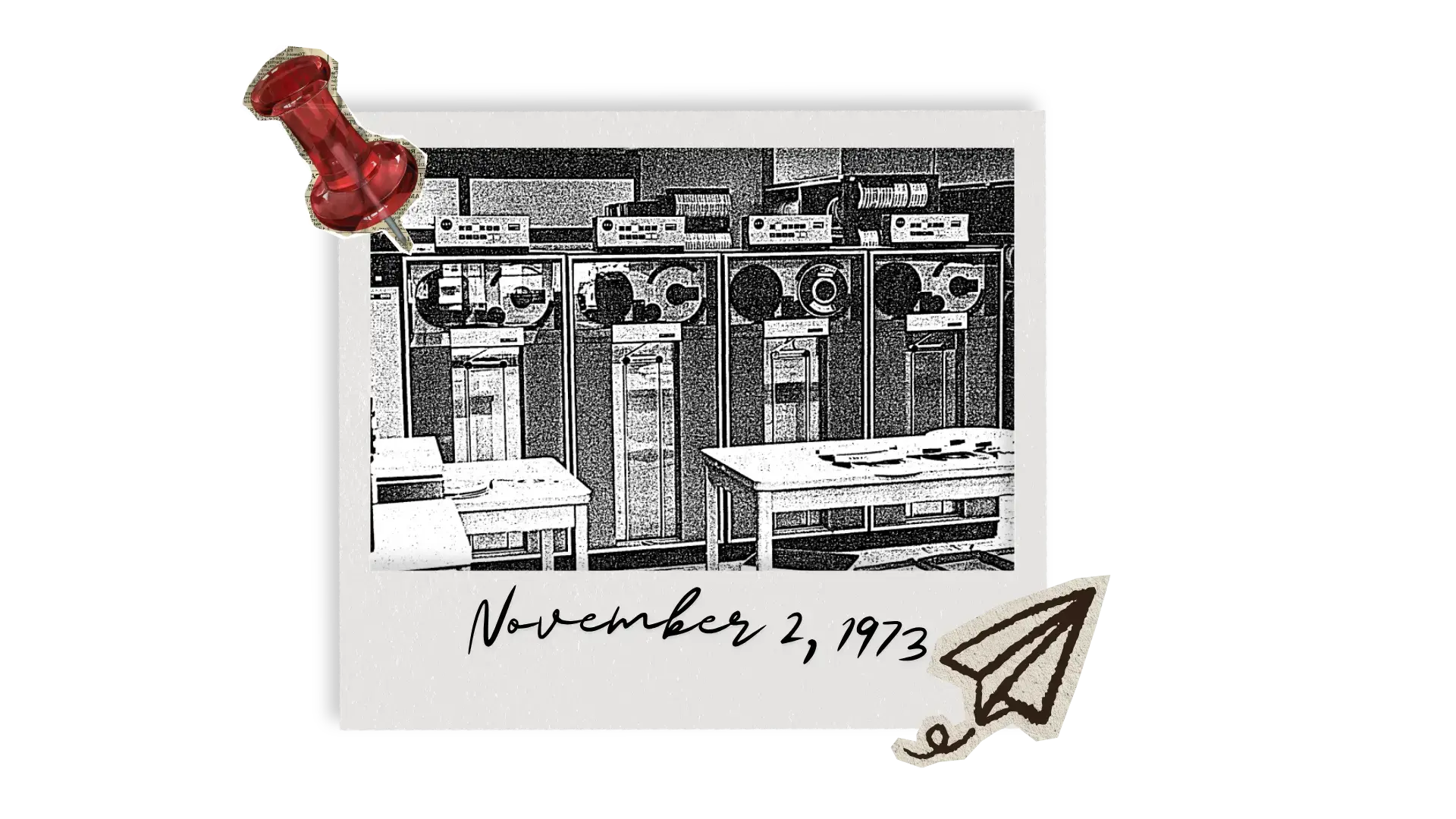
      <![CDATA[<p><img src="https://scholastic.nd.edu/assets/681339/original/lee_2_.webp" alt="" width="1139" height="641">“It used to take students four or five classes to analyze the total form of a sonnet. Now, once the sonnet is key punched and fed into the computer, its form can be analyzed in only two minutes,” marvelled Dr. Edward Kline, former Director of Graduate Studies in English at Notre Dame.</p>
<p>It was 1973, and humanities scholars were just beginning to explore what computers could make possible for literary study. Dr. Kline’s enthusiasm in a <em>Scholastic</em> interview now offers a striking contrast to professors’ attitudes toward AI today.</p>
<p>Before Claude, ChatGPT or even Google, there were key punch machines and mainframe computers. Kline explained that a keypunch machine, “very similar to a typewriter,” punched information onto physical cards, which were then fed into a computer for an analysis. “I think their future is bright,” declared Kline.</p>
<p>What pushed computers further into the humanities at Notre Dame was PL/I, a programming language that worked with text, and LINGUASLEUTH, a program for poetry and prose. Developed with Notre Dame programmers Kook Huber and Marlyn Ritchie, LINGUASLEUTH acted like an early literary search engine: It could count words, identify patterns and rhymes, compare writing styles and recognize authorship and influence.</p>
<p>Still, excitement existed alongside an age-old fear: machine takeover. Asked whether computerized analysis could “kill emotional response, the true nature of literature,” Kline and Huber were confident. Kline argued computers were incapable of thinking, while Huber added that computers could analyze form but “never give the meaning of a work.”</p>
<p>Back then, there seemed to be a clear line between the computer’s role in assisting learning and the learner’s role in thinking critically. Today, that line has blurred, leading many classes to go technology-free or prohibit AI altogether. Kline’s interview highlights that changing attitude, as what was once a question of how much technology could assist learning has now become a question of how much it could inhibit it.</p>]]>
    </content>
    <link rel="enclosure" type="image/webp" href="https://scholastic.nd.edu/assets/681339/lee_2_.webp" title="an old Scholastic from Nov 2, 1973, showing the Keypunch machine."/>
    <author>
      <name>Anna Cooley</name>
    </author>
  </entry>
  <entry>
    <id>tag:scholastic.nd.edu,2005:News/185862</id>
    <published>2026-10-07T14:30:00-04:00</published>
    <updated>2026-10-04T17:43:23-04:00</updated>
    <link rel="alternate" type="text/html" href="https://scholastic.nd.edu/issues/from-dome-to-dome/"/>
    <title>From Dome to Dome</title>
    <summary type="text">
      <![CDATA[How alum Michael Boland leverages Catholic social teaching and policy to shape AI guardrails through his company, Dome Compass.]]>
    </summary>
    <content type="html">
      <![CDATA[<p>When Michael Boland graduated from Notre Dame with a government and international relations degree in 1975, he did not expect the economic reality he would encounter over the next 50 years that would put his Catholic education to the test. To put things into perspective, in 1975 IBM launched their first portable computer, and J. Paul Getty was considered the world’s wealthiest person after earning his fortune in lucrative Saudi-Kuwaiti oil concessions in the 1950s. In the technologically evolved 2026 economy, Boland lives in the center of our nation’s federal government — while seeing firsthand the simultaneous evolution of generative artificial intelligence (AI) systems into smartphones, along with Elon Musk’s autonomous vehicle and space exploration ventures making him the world’s first trillionaire.</p>
<p>During an interview with <em>Scholastic</em> on Sept. 10, Boland described his vocation of linking AI with public policymakers as part of a longstanding moral imperative of the Catholic Church to preserve the essence of humanity. While discussing his role in a bipartisan group of investors that launched Dome Compass Inc in 2015, he invoked the commonality from the papal encyclicals “Rerum Novarum” (1891) and “Magnifica Humanitas” (2026) that “eliminating any opportunity for goods and money to transcend the idea of the development of every human being must be nonpartisan and non-negotiable.”</p>
<p>Further, Boland drew a parallel to his experience of advising government officials and housing market investors during the 2008 financial crisis by referencing recent developments in the world of AI — including the widely publicized resignation of Anthropic researcher Jacob Coxon over claims that his company was more focused on profit than prevention of a “superhuman technology that can revolutionize any field overnight with unceasing progress.” It would also be important to note that the CEO of Anthropic came forward less than five days after the interview, calling for an immediate slowdown in developing a technology of his own making.</p>
<p>In creating Dome Compass, Boland hoped to take his expertise into the fight of confronting the simple supply and demand fluctuations of AI development today — while giving his alma mater the first dibs at neutral, civil discourse in policy formation. On the urgency of the matter, Boland emphatically noted that the problems with this new technology aren’t only based in the “predictably sparse supply of trust in its development, but because there is a significant gap in the cost-benefit analysis of projected revenues from AI infrastructure investments,” mainly in the form of data centers.</p>
<p>The publishing of “Rerum Novarum” was intended to be a direct moral response to the upheavals between socioeconomic classes during the Industrial Revolution — a distinct parallel to one of Boland’s recent examples of data center investor and billionaire Kevin O’Leary calling out two female critics of his new Utah data center project as members of the Chinese Communist Party. Boland shares the view that market movers in AI development are “part of an overhyped and temporary economic bubble with [distinct] social costs,” and that extreme responses to resistance like this are part of a greater theme that policymakers can only address with the unconditional help of academics and advocates: AI has already gone rogue.</p>
<p>Boland’s story shows how a Notre Dame education brought him to the impressive feat of overcoming the hyperpolarization that has flooded our nation’s capital by working with real academics from his alma mater to foster civil dialogue on a pressing matter. This message carries a touch of irony, given that the university’s internal policy on AI has given faculty the autonomy to dictate the use of the technology so long as it remains a supplement to further developing the gifts and talents that students bring to the campus community.</p>
<p>It isn’t just academic communities that are struggling to develop a concrete approach to AI — as Boland has identified — since many policymakers take an oddly direct, hostile position toward the technology while its benefits and threats continue to evolve with it. In my time working with the Office of U.S. Senator Elissa Slotkin, for example, the standard set by the office was that AI may not be used in work under any circumstances — amplifying the divided perspectives among lawmakers on how to balance the potential and risks of AI.</p>
<p>Frankly, Boland recognizes that “the University of Notre Dame and the Catholic Church are well-positioned” to contribute to the conversation of how regulation of AI evolves over time. In the rare occurrence of industry leaders calling for more developmental oversight from the government in their own industries, the top Republican and Democrat in the House of Representatives agreed in Sept. 13 interviews that Congress should put guardrails in place — potentially foreshadowing more dialogue opportunities for university officials with the continued support of Boland.</p>]]>
    </content>
    <link rel="enclosure" type="image/jpeg" href="https://scholastic.nd.edu/assets/680532/unnamed_2.jpg" title="courtesy of LegiStorm"/>
    <author>
      <name>Liam Reynolds</name>
    </author>
  </entry>
  <entry>
    <id>tag:scholastic.nd.edu,2005:News/185901</id>
    <published>2026-10-07T14:30:00-04:00</published>
    <updated>2026-09-30T14:47:08-04:00</updated>
    <link rel="alternate" type="text/html" href="https://scholastic.nd.edu/issues/i-asked-chatgpt-to-make-me-a-perfect-4-0-student/"/>
    <title>I Asked ChatGPT to Make Me a Perfect 4.0 Student</title>
    <summary type="text">
      <![CDATA[I would consider myself to be a mostly responsible student. I go to class, do my assignments on time and Google Calendar is my best friend. So when I asked ChatGPT to make me the “perfect” Notre Dame student, I wasn’t looking to completely change my schedule, but instead to optimize it. ChatGPT’s…]]>
    </summary>
    <content type="html">
      <![CDATA[<p>I would consider myself to be a mostly responsible student. I go to class, do my assignments on time and Google Calendar is my best friend. So when I asked ChatGPT to make me the “perfect” Notre Dame student, I wasn’t looking to completely change my schedule, but instead to optimize it.</p>
<p>ChatGPT’s solution began at 5:45 a.m. The schedule demanded an early morning lift followed by a nutritious breakfast and a review of accounting concepts. Apparently my usual alarm at 8:30 a.m. is not making the cut. The day before, I accidentally chugged an energy drink too late in the day, so I wasn’t able to fall asleep until midnight. After laying awake, I moved my alarm to 7:45 a.m. At 7:45 a.m., I actually did get up and work out. This was a major accomplishment for me, being that I managed to wake up 45 minutes earlier than usual. I am now officially an overachiever. I replaced Chat’s nutritious breakfast with a granola bar and half of an energy drink, which sadly was all I had time for.</p>
<p>By 10 a.m. I was walking to Mendoza for office hours. At least I almost was — until I spotted my friend’s location in the library and decided that checking in on them wouldn’t hurt. I got away with stealing 20 minutes that Chat had not allotted me. Still, I made it to Mendoza a little after 10:30 a.m., where I was able to answer all of my questions. I’m finally ahead of schedule. Feeling like the genius Chat is helping me become, I went back to Hesburgh and studied accounting for another hour before Foundations of Leadership at 12:30 p.m.</p>
<p>After lunch, my roommate invited me to study in Hesburgh. When I got there, I realized I had completely missed the Women in Business cupcake social. My meticulously optimized schedule was officially falling apart. I then noticed another problem: I was supposed to be doing coding and philosophy. Instead, I was so stressed about accounting I absolutely had to keep reviewing. At 4:45 p.m., I took my generous “40 minute break” early so I could lie on my new boneless couch and scroll. Then I went to my 6 p.m. meeting which ended a half hour early. Great! I had recovered some time.</p>
<p>Of course, I immediately lost it again. I went to go pick up my makeup bag that I left in my friend Ellanie’s room. We had “a few things to discuss” and an hour later it was already 8 p.m. According to Chat, I was supposed to be finishing philosophy and planning out some future goals. Cherry on top, I was also supposed to be in bed by 9:30 p.m. I decided to abandon my future and my philosophy reading to write this article instead.</p>
<p>I think ChatGPT forgot to take a few things into consideration when making me the perfect student. One of them was leaving absolutely no space for social interaction. AI might be able to make me more productive — it might even make me a better student — but it cannot optimize the parts of college that make it worth experiencing. Honestly, if being the perfect student means waking up at 5:45 a.m. and being in bed by 9:30 p.m., I think I’ll just settle for being pretty good.</p>
<figure class="image image-right"><img src="https://scholastic.nd.edu/assets/680772/ai_as_military_sarg.webp" alt="Artwork by Ashlynne Bracamonte" width="600" height="763">
<figcaption>Artwork by Ashlynne Bracamonte</figcaption>
</figure>]]>
    </content>
    <link rel="enclosure" type="image/jpeg" href="https://scholastic.nd.edu/assets/680771/ai_as_military_sargjpg.jpg" title="artwork by Ashlynne Bracamonte"/>
    <author>
      <name>Raquel Arista</name>
    </author>
  </entry>
  <entry>
    <id>tag:scholastic.nd.edu,2005:News/185904</id>
    <published>2026-10-07T14:30:00-04:00</published>
    <updated>2026-09-30T14:46:56-04:00</updated>
    <link rel="alternate" type="text/html" href="https://scholastic.nd.edu/issues/catapult-technology/"/>
    <title>Catapult Technology</title>
    <summary type="text">
      <![CDATA[What are those sports bras every athlete is wearing over their clothes?]]>
    </summary>
    <content type="html">
      <![CDATA[<h3><span style="text-decoration: underline;">Payton Dymek</span></h3>
<p>Growing up, I was a regular attendee to the Arizona State University vs. Stanford volleyball matches. I vividly remember my first couple of times going, noticing that the girls would wear a black vest that resembled a sports bra on top of their jerseys during warm-ups and cool-downs. At the time, I didn’t understand the intersection of technology and sport; however, now it’s important to see that athletics would not be where it is today without data collected from these devices.</p>
<p>Catapult has been coined as “the most high-tech bra you’ve ever seen,” acting as a GPS monitoring system that tracks athletes during training or games, working to capture and analyze every aspect of performance, but it is simple to understand when you break down the technology. The tracking is done through a small unit inside the vest or pouch (depending on what you’re wearing), which collects data on total distance, high-speed distance, maximum velocity and a host of more advanced performance metrics. Nearly every major league and team around the world uses the Catapult system to its advantage.</p>
<p>With clients ranging from Notre Dame to Manchester United, Catapult’s client base is immense.</p>
<p>In the sport of football specifically, Catapult helps teams quantify training, mitigate injury risk and support return-to-play programs through performance benchmarking. Its sensors collect movement-specific data, allowing teams to analyze both individual players and the team as a whole. Specific features include positional analysis, contact load and total load. All of these tidbits of information provide training staff with cutting-edge information on their team’s physical performance.</p>
<p>However, even with the influx of information provided by Catapult, intention is crucial. As Notre Dame sports performance director John Wale told Pete Sampson of The Athletic in a 2023 article regarding the Irish’s use of sports technology, “It’s not necessarily who’s collecting the most things, or who is equipping their staff with the most technology or their different tools. It’s really who can maximize what they are getting from each one of those things.”</p>
<p>It’s important to note Notre Dame doesn’t just limit its use of Catapult technology to football. The technology has also become a key component in training methodologies behind nearly every other sport on campus including soccer, lacrosse and volleyball.</p>
<p>Perhaps Catapult’s most important metrics is its PlayerLoad measurement. Rather than simply tracking how far or fast an athlete moves, PlayerLoad uses accelerometer data to quantify the overall physical workload an athlete undertakes. The metric can be measured instantaneously by dividing the change of acceleration by a scaling factor. The PlayerLoad stat allows coaches to determine when athletes have pushed harder and need a break or can dial up the intensity. Catapult provides teams with objective data to inform these decisions.</p>
<p>With Catapult technology now being used in over 128 countries across over 40 sports and 5500 elite teams globally, it’s inevitable that not only has technology truly shaped athletic performance analysis, but it will continue to grow. As this growth occurs, it will be important to question to what extent analysts use data to empower athletes and support training before the human unpredictability, which makes sports such a spectacle, is taken away.</p>

<h3><span style="text-decoration: underline;">Chris Dailey's Response</span></h3>
<p>Ah, AI in sports. It has always been inevitable, right? There’s always a genius out there creating some new gadget that an analytics department will purchase to provide its program with cutting-edge technology.</p>
<p>On the surface, I’m all for it. In fact, devices such as Catapult have done wonders for sports teams around the world in providing information on miles logged, heart rate, PlayerLoad and so much more.</p>
<p>So why am I kind of against it?</p>
<p>Maybe it’s because I’m old school. I was raised under the instruction to “act like you’ve done it before” whenever I scored a goal or made a basket. Sports, to me, have always been about grit, toughness and playing your heart out. The more obsessed we become about numbers, the more the very essence of sports is lost.</p>
<p>As a coach, I’d take the player willing to make a slide tackle in the mud over the one who checks every statistical box. That’s not to say Catapult and similar technologies don’t have tremendous value. If data can prevent an injury or help an athlete understand their body, then teams should be all over it. But, allowing the data to dictate every little decision is a major problem.</p>
<p>The true beauty of sports lies in rolling up the sleeves and giving everything you have. Not jargon about “PlayerLoad” and “Performance Metric.” Use the numbers. Learn from them. Just don’t let them replace the grit that makes sports the universal connector.</p>
<p>But hey, maybe I’m just old school.</p>]]>
    </content>
    <link rel="enclosure" type="image/jpeg" href="https://scholastic.nd.edu/assets/680778/mbb_2627_practice_826_pm_0162_diallo_2.jpg" title="THE CATAPULT SYSTEM IN ACTION&#10;Notre Dame athletes of many sports utilize this advanced technology to capture crucial metrics while training."/>
    <author>
      <name>Payton Dymek and Chris Dailey</name>
    </author>
  </entry>
  <entry>
    <id>tag:scholastic.nd.edu,2005:News/185905</id>
    <published>2026-10-07T14:30:00-04:00</published>
    <updated>2026-09-30T14:55:28-04:00</updated>
    <link rel="alternate" type="text/html" href="https://scholastic.nd.edu/issues/fighting-irish-is-ai-a-good-substitute-for-human-relationships/"/>
    <title>Fighting Irish: Is AI a Good Substitute for Human Relationships?</title>
    <summary type="text">
      <![CDATA[Some users of AI have found an unexpected utility ... emotional support. Do you agree with Reese's "yae" or Ariel's "nay" argument?]]>
    </summary>
    <content type="html">
      <![CDATA[<h2>YAE! You've Got a Friend in AI</h2>
<h4><span style="text-decoration: underline;">Reese Hillman</span></h4>
<p>Humans are social creatures. It is imbued in our very being to form connections with those around us and feel an immense sense of longing should we fail. Now more than ever, there is a severe lack of healthy social interactions within younger generations. Perhaps it is growing up surrounded by technology, the after effects of COVID, or some other confounding variable, but it is evident in the uptake of online users turning to chatbots for comfort, advice and even romantic relationships.</p>
<p>I firmly believe that artificial intelligence can never truly replace human relationships and should be used with caution. However, it’s here to stay and ever-growing. The question remains: Is there any situation in which it can be beneficial to chat with an AI platform as though it were another human? I believe the answer can be ‘yes’ should it follow certain guidelines. First, there is no realm where forming a romantic relationship with AI is healthy. Second, if you find that you are dependent upon a chatbot for daily social communication, it is certainly not a healthy alternative to a human relationship. Yet, I see no serious harm in occasionally using AI to assuage minor anxiety, suggest solutions to a problem or even provide relationship advice.</p>
<p>In a momentary spiral, it can be useful to briefly chat with AI. If you need someone to tell you plainly that you are overthinking or that the world won’t implode, it may be helpful to send a quick chat to an AI. The same applies to email advice, date ideas, questions about symptoms you’re experiencing and other similar prompts. It is better to talk to someone than bottle up negative thoughts and emotions. If you refuse to speak to another human, I’d argue that it is better to chat with AI than remain silent. In doing so, users can process their thoughts and save themselves from potential episodes of panic. These conversations are not always accurate. Should you choose to communicate with AI in the above ways, fact-check the information you’re reading. Lastly, should you become dependent on AI in a social context, or should you become increasingly anxious following these conversations, please consult a mental health professional, speak with your rector or resident priest and perhaps join a club on campus so that you can meet others with similar interests.</p>

<h2>NAY! Don't Confuse Convenience for Connection</h2>
<h4><span style="text-decoration: underline;">Ariel Medina</span></h4>
<p>In a culture obsessed with convenience, AI has quietly slipped into spaces where it doesn’t belong. People ask chatbots for dating advice, emotional support or even guidance through depression. But no matter how advanced the technology becomes, AI cannot offer what humans fundamentally need: genuine connection. Human relationships are not optional accessories to life, but a structure that holds us up. If anything, relying on AI for emotional clarity is like trying to warm yourself with a picture of a fire. It looks convincing, but it will never give you real heat.</p>
<p>Growing up in a traditional Hispanic household, I was taught to handle my problems with resilience and honesty. You talk to people you trust, you face what hurts and you keep moving. That doesn’t mean emotions aren’t serious, because they are. Depression is real, and navigating it requires care, patience and community. What worries me today is how easily people turn to AI for quick reassurance. A chatbot will always agree with you, validate you and give you the “right” answer. But easy answers aren’t the same as truthful ones, and they certainly aren’t the same as human support.</p>
<p>AI can mimic empathy, but it cannot feel it. It can generate your favorite comforting words but cannot possibly understand the weight behind them. When someone confides in a machine, they’re not building trust but outsourcing vulnerability. And vulnerability is the foundation of every meaningful relationship, whether romantic, platonic or somewhere in between. You cannot build a marriage, friendship or sense of self with a thing that has no lived experience.</p>
<p>Human connection is irreplaceable because it’s messy, unpredictable and real. It challenges us to conquer character-shaping experiences which then lead to our overall evolution. Yes, AI offers the shortcuts, but shortcuts rarely lead anywhere worth going. At the end of the day, when it comes to mental health, relationships and identity, a machine is only going to echo your words. Only a human can meet you where you are.</p>]]>
    </content>
    <link rel="enclosure" type="image/webp" href="https://scholastic.nd.edu/assets/680782/ai_friendship_3.webp" title="ChatGPT bro-hugging Notre Dame students."/>
    <author>
      <name>Reese Hillman and Ariel Medina</name>
    </author>
  </entry>
  <entry>
    <id>tag:scholastic.nd.edu,2005:News/185959</id>
    <published>2026-10-07T14:30:00-04:00</published>
    <updated>2026-10-04T17:48:59-04:00</updated>
    <link rel="alternate" type="text/html" href="https://scholastic.nd.edu/issues/scrolling-for-soulmates/"/>
    <title>Scrolling for Soulmates</title>
    <summary type="text">
      <![CDATA[Dear techies,  In our modern society, technology has infiltrated all aspects of our lives. That includes the most awkward, uncertain, exciting form of human interaction there is — dating. From the apps to textuationships, Notre Dame students’ habits with digital tech in romance reveal insights…]]>
    </summary>
    <content type="html">
      <![CDATA[<p>Dear techies, </p>
<p>In our modern society, technology has infiltrated all aspects of our lives. That includes the most awkward, uncertain, exciting form of human interaction there is — dating. From the apps to textuationships, Notre Dame students’ habits with digital tech in romance reveal insights into the nature of our campus dating culture.</p>
<p>Last semester, a friend of mine set me up with a guy. Let’s call him Liam. We electronically exchanged polite logistics, making plans for a date. Liam was a good-looking former athlete, but unfortunately, he was a little shy. A few nights before our date, he struck up an extended conversation through text. We messaged back and forth, bubbles appearing and texts flying from “delivered” to “read” before any thoughts were complete. I was excited to have this newfound compatibility but nervous about the application to real life. Per my expectations, Liam was tight-lipped throughout the date. I tried to re-ignite the jokes we shared over text, but there was an awkward tension without the screen barrier.</p>
<p>Developing a relationship online makes for a rocky transition to real life. Liam ultimately got what he wanted: an official girlfriend he met and communicated with entirely through Instagram DMs. Truly modern romance at its finest.</p>
<p>If you think Instagram is bad, the dating apps aren’t much better on campus. Notre Dame is too small, meaning your potential matches are either 30-something townies or a jump scare from your student manager (which led me to immediately turn off my profile). However, I can tell you that they are well-designed for a big city with lots of young singles, like most study abroad destinations.</p>
<p>My first ever Hinge date came about during my time overseas. I had just landed in my new home city, opened a profile to browse the local options and ran into someone who had matched with me. As shallow as it sounds, I didn’t even recognize him in person. In front of me stood a 6-foot-5 man with an enchanting accent who had already overcome the barrier of meeting me in person. He messaged me after our interaction, joked about the one-in-a-million coincidence and asked me on a date. I probably wouldn’t have attended a date if I hadn’t met him — he didn’t appear to be <em>exactly</em> my type in photos. It goes to show that an online persona is never actually like your in-person self. I, and many others, can tell you about the opposite of that phenomenon, when real appearances can fall short of their digital versions.</p>
<p>This encounter reaffirmed my preference for in-person interactions, but it also inspired thought on the transparency of intentions online. My friends have proven to me the other significant advantages technology brings to dating.</p>
<p>This past spring, I indirectly made a match out of two class friends. We started as a trio, but the two kept hanging out to walk around the lakes and share Sunday dinners. By summer, they both knew they wanted to make the relationship official. The only problem: They live miles away from each other. Technology bridges this gap; my friend admits that he doesn’t like that their relationship happened through a phone, but he’s grateful FaceTime and messages allowed them to remain close while in different cities.</p>
<p>Technology isn’t inherently evil. It has serious benefits for forming and sustaining relationships. However, it does become dangerous when used as a substitute for real courtship and in-person interaction. With new advancements, misuse always follows — like Liam being unable to handle talking without a screen — but much good can come out of it. For example, a 2019 study from Stanford University found that online dating is the most popular way for couples to meet.</p>
<p>In an already digitally-connected world, where physical proximity plays an increasingly weaker role in social proximity, it’s wise to use the technological tools available to assist romantic encounters, not control the relationship.</p>
<p>Use wisely, </p>
<p>The Irish Cupid</p>]]>
    </content>
    <link rel="enclosure" type="image/jpeg" href="https://scholastic.nd.edu/assets/657681/untitled_27_.jpg" title="The Irish Cupid"/>
    <author>
      <name>The Irish Cupid</name>
    </author>
  </entry>
  <entry>
    <id>tag:scholastic.nd.edu,2005:News/185960</id>
    <published>2026-10-07T14:30:00-04:00</published>
    <updated>2026-10-04T17:50:38-04:00</updated>
    <link rel="alternate" type="text/html" href="https://scholastic.nd.edu/issues/let-me-check-the-comments/"/>
    <title>Let Me Check the Comments</title>
    <summary type="text">
      <![CDATA[During my routine doomscroll-and-rot-on-my-couch ritual after class, I find myself instinctively clicking on the chat bubble icon to access the comments on TikTok. Before I’ve even decided what I think, I turn to the thousands of anonymous users for their expert opinions and astute observations on…]]>
    </summary>
    <content type="html">
      <![CDATA[<p>During my routine doomscroll-and-rot-on-my-couch ritual after class, I find myself instinctively clicking on the chat bubble icon to access the comments on TikTok. Before I’ve even decided what I think, I turn to the thousands of anonymous users for their expert opinions and astute observations on a video of Clavicular walking into an Erewhon for the first time. I’m met with “He’s unironically the funniest person on the internet sometimes,” “I feel maternal towards him idc,” and “He’s grocerymaxxing.” Consequently, I find myself thinking, “yeah, maybe Clav is pretty funny.” However, is that what I really think, or what I’m being told to believe? I’m met with this dilemma in almost every video that comes across my feed, whether it’s TikTok, Instagram Reels or even YouTube Shorts.</p>
<p>The same thing happens when I try to buy anything. Before I order a new mascara, I’ve watched six TikToks, read four Reddit threads and skimmed a Marie Claire listicle ranking the “8 Best Mascaras for Falsies-Level Length and Volume,” every source contradicting the last. By the time I actually decide, I’ve wasted forty minutes, and I end up choosing whichever reviewer got paid the most money or whichever video had the most likes. How often am I really thinking for myself when I go on social media every day? When constantly exposed to the opinions of others, how much of what I say can I really claim as mine? Who am I if not the mosaic of every viral trend and corny saying I’ve ever seen?</p>
<p>People have always been shaped by what other people think. But there is a difference between a thoughtful conversation with a friend and a comment section that hands you a fully formed take before you’ve had thirty seconds to react. While I can at least applaud myself for recognizing this habit, children with social media access may not have that same self-awareness. Children are already looking to the world around them to figure out what is funny, cool, embarrassing or worth caring about. Social media gives them an endless stream of answers: The most liked comment is the funniest joke; the most viral fit check is the coolest outfit; the most stitched video is the cringiest moment. None of these are sinister on their own, but together they leave increasingly little room for a child to decide, without consulting an audience, “I like this,” “I don’t like this,” or even “I don’t know yet.”</p>
<p>Childhood is when we’re supposed to learn how to sit with questions long enough to actually answer them. And, with the advent of AI, it’s easier than ever to get a second opinion without ever forming one yourself. Why wrestle with a difficult question if ChatGPT can give you the perfect answer? For children still developing their sense of self, that convenience comes at a cost. If every question can be answered and every opinion supplied, we risk raising a generation that knows how to find an answer but not how to arrive at one on their own.</p>]]>
    </content>
    <link rel="enclosure" type="image/webp" href="https://scholastic.nd.edu/assets/681294/untitled_september_26_2026_at_145126.webp" title="Text message bubbles"/>
    <author>
      <name>Ellie Fischer</name>
    </author>
  </entry>
  <entry>
    <id>tag:scholastic.nd.edu,2005:News/185963</id>
    <published>2026-10-07T14:30:00-04:00</published>
    <updated>2026-10-04T18:20:07-04:00</updated>
    <link rel="alternate" type="text/html" href="https://scholastic.nd.edu/issues/war-by-algorithm/"/>
    <title>War by Algorithm</title>
    <summary type="text">
      <![CDATA[AI is now being used in war. I experienced this firsthand living in the Middle East.]]>
    </summary>
    <content type="html">
      <![CDATA[<figure class="image image-left"><img src="https://scholastic.nd.edu/assets/681305/fullsize/wadirum.jpg" alt="A Bedouin man in the 74,000-acre desert, Wadi Rum (southern Jordan). The Bedouin, a nomadic Arab group, have inhabited the region for centuries." width="1170" height="1628">
<figcaption>A Bedouin man in the 74,000-acre desert, Wadi Rum (southern Jordan). The Bedouin, a nomadic Arab group, have inhabited the region for centuries.</figcaption>
</figure>
<p>Reconciling with the changes artificial intelligence brings means professors scrambling to create reasonable boundaries surrounding its usage, students trying to determine whether their critical thinking skills are diminishing and all of us justifying the environmental costs of data centers. To us, university students living in the West, this new era of technology is scary, but one that will undoubtedly make life more efficient. Efficiency is the driving force behind this rise in AI; it accelerates productivity to such an extent that we often fail to remember what this threat of efficiency means in the context of war.</p>
<p>The Guardian reports that efficiency in war means moving from manually identifying <a href="https://www.theguardian.com/world/2023/dec/01/the-gospel-how-israel-uses-ai-to-select-bombing-targets">50 targets</a> per year within a given region to suddenly having 100 targets generated in a single day. It means allowing operators to strike those targets <a href="https://www.csis.org/analysis/what-maven-smart-system-and-what-does-it-do">without switching interfaces</a>. It means instantly producing databases of tens of thousands of people authorized for assassination — each person reduced to a single phone signal. AI made this scale of efficiency possible.</p>
<figure class="image image-right"><img src="https://scholastic.nd.edu/assets/681307/fullsize/petra2.webp" alt="A Bedouin tent and tea stall along a cliffside trail at Petra." width="1170" height="854">
<figcaption>A Bedouin tent and tea stall along a cliffside trail at Petra.</figcaption>
</figure>
<p>I bore witness to this deadly level of efficiency while on the roof of my apartment in Amman, Jordan. Throughout my years living in the Middle East, I watched missiles fly above my home and vaporize into a deep blue halo as they were intercepted, their sheer force shaking my bedroom windows. This eventually culminated in the exchange of fire between the U.S., Iran and Israel; suddenly, the targets AI had been able to compile within seconds were buildings and infrastructure directly next to my apartment complex.</p>
<figure class="image image-right"><img src="https://scholastic.nd.edu/assets/681308/fullsize/amman2.jpg" alt="The King Abdullah I Mosque in Amman, Jordan." width="1170" height="1513">
<figcaption>The King Abdullah I Mosque in Amman, Jordan.</figcaption>
</figure>
<p>Fortunately, I was never in real danger. I had the resources and capabilities to leave — that is far luckier than many families and people across the Middle East. While living in Jordan, I had the opportunity to talk to refugees from Iraq, Palestine and Syria: children, working men, mothers and teenagers who were displaced by this newfound efficiency. While I only ever watched the weaponization of AI hundreds of miles above me, these people saw it manifested in the obliteration of their homes, the death of family members and the loss of jobs and futures.</p>
<p>Each individual story can now be reduced to a “collateral damage score”: a number stipulating how many citizens would be killed in a given strike, calculated by the IDF’s AI target-creation platforms. While each strike must be authorized first by a human, it becomes much easier to simply accept that collateral damage score as a small consequence when the complexity of a person’s story is reduced to a single number.</p>
<figure class="image image-left"><img src="https://scholastic.nd.edu/assets/681309/fullsize/ummqais.jpg" alt="Northern Jordan — featuring ruins of the ancient Greco-Roman city, Gadara." width="1170" height="805">
<figcaption>Northern Jordan — featuring ruins of the ancient Greco-Roman city, Gadara.</figcaption>
</figure>
<p>That same depersonalization accompanied more than 1,000 strikes across Iran within the first 24 hours of the 2026 war. The Center for Strategic and International Studies reports this was <a href="https://www.csis.org/analysis/what-maven-smart-system-and-what-does-it-do">“a tenfold increase over what was possible”</a> before the U.S.’s new Pentagon initiative that brought AI to warfare. One of those strikes was on the Shajareh Tayyebeh Elementary School in Minab — an action ultimately responsible for the death of more than 100 girls, per Amnesty International. While the attack is still under investigation, the possibility that AI identified the school as a target based on outdated intelligence represents the fatal consequences of automated targeting.</p>
<p>It seems to be increasingly evident that AI is sanitizing the act of war. War used to be a haunting commitment in which either side was directly exposed to the brutality and violence of their actions — each human loss was felt. Now, AI is assisting in making that loss distant.</p>
<figure class="image image-right"><img src="https://scholastic.nd.edu/assets/681306/fullsize/amman.jpg" alt="Street art in Jabal al-Weibdeh, a neighborhood in Downtown Amman, Jordan." width="1170" height="805">
<figcaption>Street art in Jabal al-Weibdeh, a neighborhood in Downtown Amman, Jordan.</figcaption>
</figure>
<p>In the Western world, this specific implication of AI is literally an ocean away from us; it’s completely intangible to imagine it being a determining factor in our life and death. Despite how hard governments seem to be fighting to diminish each human life down to a number, we must actively combat that narrative by remembering those devastated by war. The only way to maintain that humanity, to ensure each life is held in as much regard as the next, is to continue to do one of the only things AI can not do — to feel and love for those separated from us by only an ocean. We can never disregard how lucky we are to not be a part of an AI-generated collateral damage score.</p>]]>
    </content>
    <link rel="enclosure" type="image/jpeg" href="https://scholastic.nd.edu/assets/681306/amman.jpg" title="Street art in Jabal al-Weibdeh, a neighborhood in Downtown Amman, Jordan."/>
    <author>
      <name>Finley McCown</name>
    </author>
  </entry>
  <entry>
    <id>tag:scholastic.nd.edu,2005:News/185968</id>
    <published>2026-10-07T14:30:00-04:00</published>
    <updated>2026-10-04T19:12:35-04:00</updated>
    <link rel="alternate" type="text/html" href="https://scholastic.nd.edu/issues/but-im-only-human/"/>
    <title>But I'm Only Human</title>
    <summary type="text">
      <![CDATA[Creative Arts in the Age of Artificial Intelligence]]>
    </summary>
    <content type="html">
      <![CDATA[<p>“Global destruction is beyond my pay grade,” said actress Tilly Norwood in her September interview with CBS’s Leigh Kiniry.</p>
<p>Norwood, a generative AI created by producer Eline Van der Velden, is currently advertising her upcoming movie, “Misaligned,” and her recent entry into the film industry has become a source of great controversy and tension in Hollywood.</p>
<p>Though Norwood is strictly an actress, her newfound fame speaks to a greater fear in all sectors of art: Is AI the death of human creativity?</p>
<p>With AI-generated art becoming a sensation on social media, many artists wonder where their futures lie, and Tilly Norwood is only one example of how the film industry is encountering AI. As these machines climb to the forefront of society, people must pause to consider whether AI is a threat or an asset.</p>

<h2>Visual Arts</h2>
<p>Since the introduction of AI to creative industries, artists have expressed numerous frustrations about its ability to produce truly valuable art.</p>
<p>Many of these concerns are rooted in AI’s fundamental capabilities, which are limited to machine learning and synthesis. Essentially, that beautiful sunset landscape with rolling hills and four monarch butterflies is not an original piece, but rather the machine’s interpretation of various images synthesized into one. If AI is using other artists’ interpretations to produce its own, then it is not “creating” art. It is simply capitalizing on others’.</p>
<p>Moreover, career prospects for artists have become increasingly uncertain. Many artists earn their living through commissioned works, marketing campaigns and similar projects. When AI can produce pieces catering to specific prompts in under a minute, artists who spend months hand-creating an item may lose relevance in the industry. It is not unlikely that they could be obsolete within the next decade.</p>
<p>Still, not all uses of AI in art are inherently harmful to artists. Many have even begun to use it as a tool. Artists seeking visual references for a project, for example, can use AI’s wealth of resources to find images, shaving hours off the creative process. Digital artists can also rely on AI to complete tedious tasks like color matching and basic editing.</p>
<p>None of these pros or cons, however, address the philosophical question facing many artists and their audiences: Does AI-generated art possess the same inherent value as human-made art?</p>
<p>Depending on whether someone prefers art for its beauty or its meaning, they may have a different opinion on what makes art “valuable.” However, those who appreciate the latter might argue that AI lacks the basic human experience necessary to create deep, resonant artwork. Still, with its efficient and flawless execution, this fundamental hiccup may become increasingly less important to audiences in the grand scheme of things.</p>

<h2>The Film Industry</h2>
<p>Alongside the fine arts, entertainment media have become susceptible to AI’s pervasive influence.</p>
<p>Since Tilly Norwood entered the scene in May 2025, she has sparked numerous debates in Hollywood, gaining the attention of the Screen Actors Guild-American Federation of Television and Radio Artists. Their fears are similar to those of many other artists: Can robots really steal the jobs of professional, human actors? Tilly Norwood might prove that they can.</p>
<p>Her existence poses a threat to the next generation of aspiring young actors seeking to break into the industry. After all, why bother with the demands of Hollywood divas or inexperienced LA waitresses when you can train a machine to run their lines instead?</p>
<p>Outside of performers, however, much is at stake for the behind-the-scenes members of a film. Ted Mandell, Associate Teaching Professor in the Film, Television and Theatre (FTT) department at Notre Dame, recognizes the role that AI can play in efficient film production.</p>
<p>“It is much like the many digital tools we use already. AI essentially streamlines processes involved, like audio enhancing or organization of footage in editing,” Mandell says in an interview with <em>Scholastic</em>. “Will that perhaps eliminate an assistant editor’s role in a film, or replace a storyboard artist, even a writer? I’m sure it has already, depending on the scale of the production.”</p>
<p>Mandell’s second point raises an important question: What will happen to the man behind the curtain — the sound designers, colorists, and picture editors who trained for so long only to be dethroned by a computer?</p>
<p>Many directors and producers, including “The Odyssey’s” Christopher Nolan, have noted that AI simply cannot replace human creativity. Mandell expresses similar criticisms, noting the same concern held by visual artists.</p>
<p>“[AI] is inherently not creative when it comes to generating new ideas. If creativity is by its nature unique, then generative AI is inherently not creative since it is trained on pre-existing content, finding similarities rather than generating unique content,” Mandell writes.</p>
<p>The modern film industry has already been attacked for peddling the same old Hollywood cliches. It seems like AI will only perpetuate this conflict.</p>
<p>Originality aside, film, at its core, relies on the human experience. The best movies are relevant when the viewer can connect so deeply with them that they become immersed. Can AI replicate that same sense of humanity? Only time will tell. However, these machines become more intelligent and advanced as time wears on, and future generations will certainly see this impact on their big screens.</p>
<p>Ultimately, despite the turmoil it causes for artists, performers and producers, AI is not going anywhere. Therefore, we have no choice but to learn how to work alongside it rather than against it.</p>
<p>An effort like this will certainly look different for different industries. Visual artists, for example, may continue pursuing their craft, employing AI to market their work. Studios may create jobs for humans to manage and/or train AI to execute certain tasks. And actors may even see AI as an opportunity to enhance their features, enabling them to assume roles they may have aged out of.</p>
<p>None of these solutions are permanent, but all of them are viable for now as we navigate this new landscape.</p>
<p>Tilly Norwood said it herself: “I see AI as a new tool, a new paintbrush, if you will, rather than a replacement for human actors.”</p>
<p>The time may have come for humans to pick up this paintbrush and design a future with AI in view.</p>]]>
    </content>
    <link rel="enclosure" type="image/jpeg" href="https://scholastic.nd.edu/assets/681330/tillynyt.jpeg" title="AI actress Tilly Norwood, courtesy of The New York Times."/>
    <author>
      <name>Sydney Moore</name>
    </author>
  </entry>
  <entry>
    <id>tag:scholastic.nd.edu,2005:News/185969</id>
    <published>2026-10-07T14:30:00-04:00</published>
    <updated>2026-10-04T19:19:32-04:00</updated>
    <link rel="alternate" type="text/html" href="https://scholastic.nd.edu/issues/seeing-is-no-longer-believing/"/>
    <title>Seeing is No Longer Believing</title>
    <summary type="text">
      <![CDATA[The year is 2022. You open TikTok and see a video of Tom Cruise doing a dance trend. Not bad for a 60-year-old man, you think. In the next video, he is touring Canada. A few scrolls later, he is vlogging from Boston. His account has nearly five million followers, and the comments are filled with people…]]>
    </summary>
    <content type="html">
      <![CDATA[<p>The year is 2022. You open TikTok and see a video of Tom Cruise doing a dance trend. Not bad for a 60-year-old man, you think. In the next video, he is touring Canada. A few scrolls later, he is vlogging from Boston. His account has nearly five million followers, and the comments are filled with people reacting to Cruise as if he were actually behind the screen.</p>
<p>There is just one problem: Tom Cruise isn’t running the account.</p>
<p>The account, @deeptomcruise, uses artificial intelligence to replicate Cruise’s face and voice, creating videos that make it appear as though the actor is actually interacting with the world around him. The creator, Miles Fisher, designed the account to demonstrate the potential dangers of AI and to raise awareness about how easily it can distort our perception of reality. Yet the account accumulated more than 19 million likes from viewers around the world. And that is exactly what makes deepfakes so unsettling: the videos don’t have to be real to feel real.</p>
<figure class="image image-right"><img src="https://scholastic.nd.edu/assets/681332/fullsize/print_issue_22_fea_cruise_main_photoshoot_h_2022jpg.webp" alt="THE MAN BEHIND THE DEEPFAKES Actor Miles Fisher is the creator of the viral @deeptomcruise account." width="1296" height="730">
<figcaption>The Man Behind the Deepfakes: Actor Miles Fisher is the creator of the viral @deeptomcruise account. Courtesy of The Hollywood Reporter.</figcaption>
</figure>
<p>Since 2022, deepfakes have become increasingly difficult to distinguish from real media. With just a photo of someone’s face and a relatively small sample of their voice, AI can now generate convincing images and videos using that person’s likeness. In the early stages of AI, we could recognize the media as a deepfake once we saw extra fingers or unnatural movements. But with fewer glitches a widespread belief that the media is real, we tend to take our sight for truth.</p>
<p>But the biggest problem with deepfakes may not be that AI can make us believe something false. It may be that we have been conditioned to believe what we see in the first place. Many of us have commonly called out, “I saw it with my own two eyes!” Up until this point, visual cues were how we confirmed our truths. But now, that certainty is disappearing. Fabricated media — some extremely explicit and harmful — can circulate on the internet for quite some time before being recognized as AI-generated. By the time the truth catches up, thousands of people may have already viewed (and believed) the picture or video.</p>
<p>And these deepfakes don’t need to take on the whole internet to be harmful. Maybe your grandma sent a video of a dog doing a backflip to the family group chat. Older people, who have never had to doubt their visual senses until now, are even more susceptible to believing what they see online. Even the most ridiculous deepfakes require a second to decipher what can and cannot be true.</p>
<p>Perhaps the only thing more concerning than what we choose to believe is what we choose not to believe. As AI deepfakes become more convincing, claiming that a genuine video is AI can become an easy way to dismiss something that actually happened. When you capture that incredible moment on camera, how can you convince others that it’s real? AI deepfakes have left us in a weird spot where we believe the fiction but are mistrustful of the truth.</p>
<p>So, what do we do now? We can’t assume that everything we see is fake, nor can we accept it as our reality right away. Instead, we have to be willing to take a pause. We have to go that one extra step and use logic to fill in the gaps. For generations, “seeing is believing” was a way to express certainty. But now, seeing may only be part of how we understand reality.</p>]]>
    </content>
    <link rel="enclosure" type="image/jpeg" href="https://scholastic.nd.edu/assets/681335/untitled_design_2.jpg" title="A glitched photo of President Donald Trump"/>
    <author>
      <name>Sophie Dandawa</name>
    </author>
  </entry>
  <entry>
    <id>tag:scholastic.nd.edu,2005:News/185972</id>
    <published>2026-10-07T14:30:00-04:00</published>
    <updated>2026-10-04T19:29:37-04:00</updated>
    <link rel="alternate" type="text/html" href="https://scholastic.nd.edu/issues/ai-tip-of-the-day/"/>
    <title>AI Tip of the Day</title>
    <summary type="text">
      <![CDATA[EG10117, or Engineering Design, is a class that is required of all first-year engineering students. Its purpose is to teach engineering students how to use specific design tools, provide students with the opportunity to…]]>
    </summary>
    <content type="html">
      <![CDATA[<p><img src="https://scholastic.nd.edu/assets/681338/original/lee_1_.webp" alt="" width="1139" height="641">EG10117, or Engineering Design, is a class that is required of all first-year engineering students. Its purpose is to teach engineering students how to use specific design tools, provide students with the opportunity to discern which engineering discipline they wish to pursue and teach students to communicate technically. One of the learning objectives of the course is for students to be able to interpret and consider ethics and virtues in the context of engineering. To aid in this goal, the EG10117 teaching team provides students with one “AI Tip of the Day” at the end of each class. The following are a sample of these tips to help you responsibly maximize AI’s capabilities:</p>
<p><strong>1. Use Gemini</strong></p>
<p>Notre Dame has an agreement with Gemini and Gemini Notebook to protect the data of students and faculty. Google will not use any data entered into Gemini to train its AI model and it will not share our data globally. Therefore, students are encouraged to only use Gemini instead of other AI tools.</p>
<p><strong>2. Self-quizzing</strong></p>
<p>You can upload lecture slides (with the permission of the professor) or your own class notes into Gemini and have Gemini generate multiple-choice questions, practice tests or flashcards. Gemini has a “Guided Learning” option as well, which allows you to study uploaded materials or learn directly from Gemini.</p>
<p><strong>3. Gemini Notebook</strong></p>
<p>This feature is not as widely known but can be extremely useful: Course instructors can create Gemini Notebooks that include course material such as the syllabus, project documents, lectures and assignments. Instead of searching Canvas pages to find the information you are looking for, all you have to do is type your prompt into the chat box. Gemini will always cite the file(s) where it found information in its response.</p>]]>
    </content>
    <link rel="enclosure" type="image/webp" href="https://scholastic.nd.edu/assets/681338/lee_1_.webp" title="Cutout of laptop"/>
    <author>
      <name>Lilianna Su</name>
    </author>
  </entry>
</feed>